The bottom line A fast, wide little refractor that gives its best at the low-power end and is advertised at the high one.
Three hundred millimetres is short
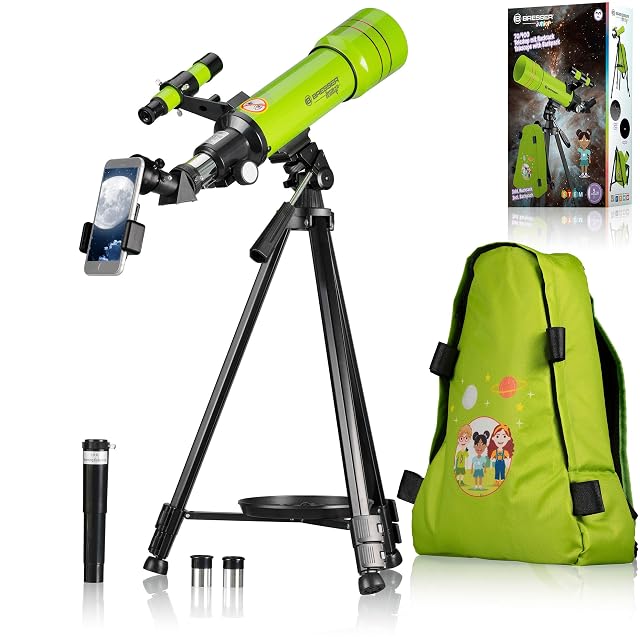
With a 70 mm objective that gives f/4.3 — one of the fastest ratios on this shelf. The consequence is a genuinely wide low-power field, which is the easiest kind of telescope for a child to find anything in, and a heavier demand on the supplied eyepieces than a long tube would make.
The arithmetic the maker publishes
Three hundred divided by twenty is fifteen; divided by six is fifty. Those are the maker’s own quoted magnifications and they are correct. The 140x that appears at the top of the same bullet comes from stacking the 3x Barlow on the 6 mm, and that is where the aperture gives up.
A proper star diagonal
Ninety degrees, not forty-five. For a telescope aimed at the sky that is the comfortable angle, and it is not what every set in this price class supplies. The 1.5x erecting lens is there for daytime use.
The specification left blank
Barrel diameter. Nothing in the listing says whether the eyepieces are 24.5 mm or 31.75 mm, and that single fact decides whether anything better can ever be fitted.
Availability
German Amazon store sat at about 39 € on the day of the survey.
British, French, Italian and Spanish Amazon catalogues hold a record for it that nobody is selling.
American Amazon store gave no result whatever, so the buy button there opens a search rather than an empty page.
Figures as Keepa reported them on the day this page was last updated. Stock and pricing shift without warning.
Prices quoted in this text were read on 17 September 2026. The live price is at the top of the page.
What it publishes, and what it withholds
Strengths
A 90° star diagonal is the right choice for a telescope pointed at the sky
The quoted 15x and 50x follow exactly from 300 divided by each eyepiece
A 3x Barlow and a 1.5x erecting lens between them cover a wide magnification range
Compromises
f/4.3 is very fast, and simple eyepieces struggle at the edge of the field
A 300 mm focal length means the highest quoted figure, 140x, is far past the aperture’s limit
No barrel diameter is stated anywhere in the listing
Specifications
Mount steadiness
Alt-azimuth, 90° vertical and 360° horizontal per the maker
Aperture
70 mm (title and bullet agree)
Focal length
300 mm (maker’s bullet)
Eyepiece fitting
Not published by the maker.
Finder type
Not published by the maker.
Tripod height
Not published by the maker.
Assembly effort
Not published by the maker.
Supplied contents
20 mm and 6 mm, giving 15x and 50x per the maker · 3x Barlow, 1.5x erecting lens, metal Moon filter, phone adapter, aluminium tripod
Amazon reference
B087BKMZT5 (same reference on 5 Amazon marketplaces)
EAN
0795890035880
What observers ask about this one
What does f/4.3 mean in practice?
A very wide field at low power, and more demand on the eyepieces. Fast ratios flare stars at the field edge with simple designs, and the effect is more visible the cheaper the eyepiece.
Is 140x reachable?
Arithmetically, with the 6 mm and the Barlow. Optically, a 70 mm aperture runs out well before that; the image gets bigger and worse. The 20 mm is where this telescope is at its best.
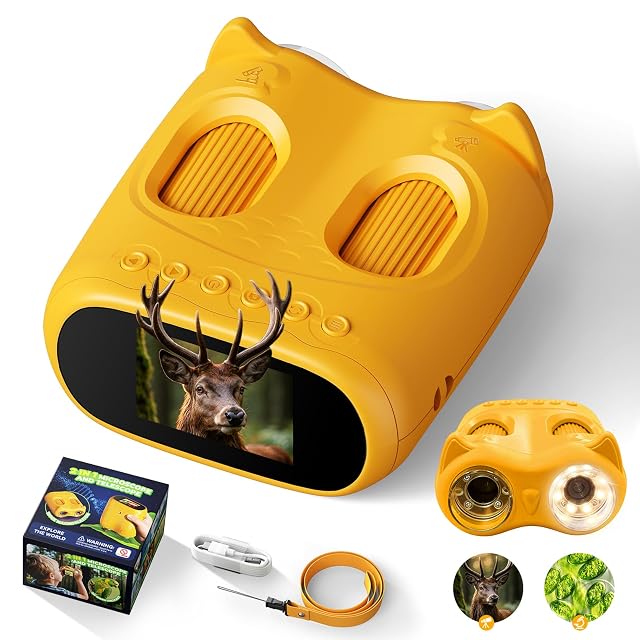
1000x hand microscope · 10x telescope · digital, 1080p
A two-in-one STEM device for children: a 1000x digital hand microscope and a 10x telescope attachment, recording 1080p stills and video to a memory card.
Best for: A child interested in insects, leaves and stones, with occasional distant viewing
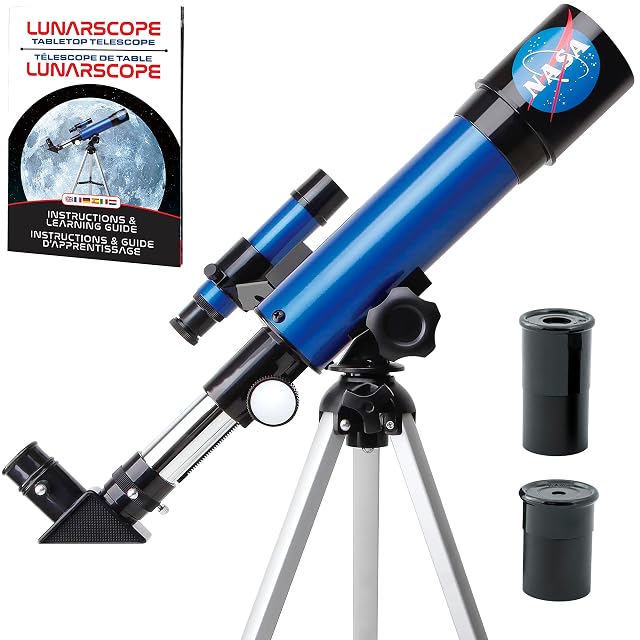
Lunar telescope · 90x claimed · no optical figures published
A NASA-branded children’s telescope for the Moon, with a wide-angle and a zoom eyepiece, a finder and a tabletop tripod — and no aperture or focal length in the listing.
Best for: A young child whose interest is the Moon and who needs no more than that