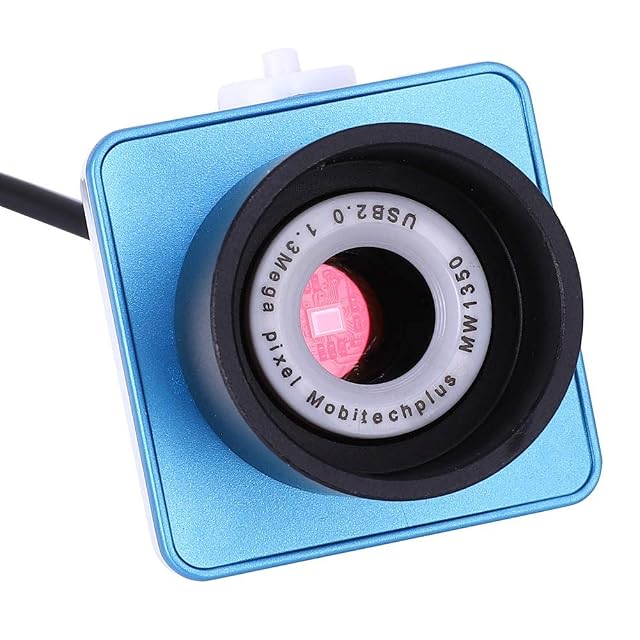
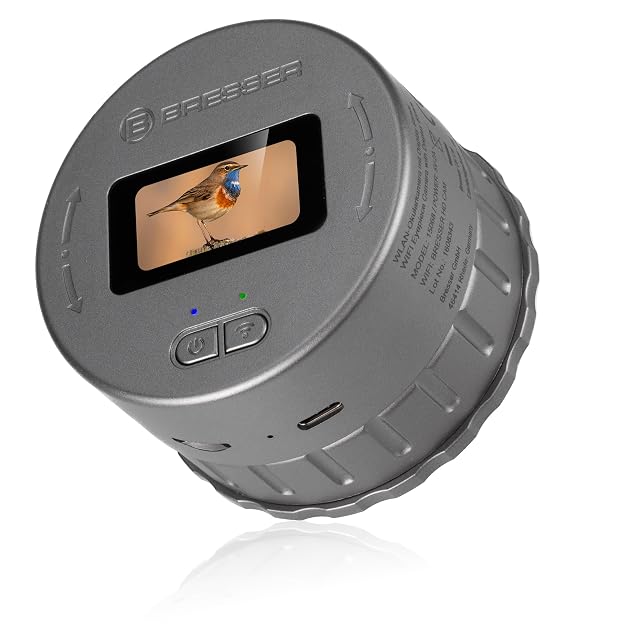
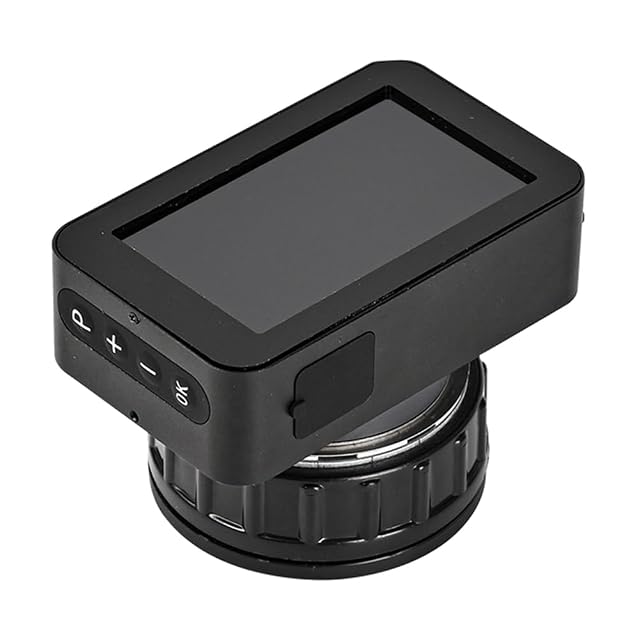
The bottom line The same class of camera as its neighbours, sold behind a listing that says one thing six times and nothing else.
A listing made of one sentence
Six of this product’s bullets are the same paragraph, word for word, with a different trailing keyword each time. A seventh is a customer testimonial. What survives as specification is: a 1.25 in barrel, USB, automatic white balance, and a repeated statement that it is not for deep-sky imaging.
What can be said with confidence
It goes into a 1.25 in focuser or a reducing adapter. It sends live video to a PC over USB. It is not intended for faint objects. That is the maker’s own description, minus the repetition.
The connection matters
The testimonial names USB 2.0. That sets a ceiling on how much data leaves the camera each second, and therefore on frame rate — which is the figure that decides how many moments of steady air get captured during a planetary run.
Buying it sensibly
As a first, inexpensive experiment in putting the Moon on a screen. Anything more demanding argues for a camera that names its sensor.
Availability
German, French, Italian and Spanish Amazon stores ran from 25 € to 38 € on the day of the survey.
British Amazon store lists it in local currency, which the euro range above sets aside.
American Amazon store gave no result whatever, so the buy button there opens a search rather than an empty page.
Figures as Keepa reported them on the day this page was last updated. Stock and pricing shift without warning.
Prices quoted in this text were read on 17 September 2026. The live price is at the top of the page.
What it publishes, and what it withholds
Strengths
Reported by the listing’s own testimonial to be recognised by common capture software
Automatic white balance removes one adjustment from a first attempt
Among the cheapest ways to get a telescope view onto a screen
Compromises
The listing is six identical bullets and a testimonial, with almost no specification
USB 2.0 limits sustained frame rate compared with USB 3.0 cameras
Neither the sensor nor any resolution figure appears anywhere
Specifications
Camera type
Replaces the eyepiece — it fits into a 1.25 in focuser
Sensor
The listing does not carry it
Pixel size
Not published by the maker.
Frame rate
The listing does not carry it
Region-of-interest capture
Not published by the maker.
Interface
USB 2.0, as mentioned in one of the maker’s bullets
Cooling
Not published by the maker.
Filter thread
Not published by the maker.
Eyepiece fitting
Not published by the maker.
Software support
Not published by the maker.
Amazon reference
B07P42F2SF (same reference on 5 Amazon marketplaces)
EAN
0719527501746
What observers ask about this one
What does the testimonial say?
One bullet quotes a customer reporting that the camera was recognised under Windows 10 and used with common capture software, delivering smooth images. It is a customer statement placed in a specification field, and it is reported here as exactly that.
Is USB 2.0 a problem?
It caps how much data per second can leave the camera, which caps the frame rate at a given resolution. For the Moon it is adequate; for planetary stacking, more frames per second means more sharp ones.
4K claimed · 3 in colour display · clamps over eyepieces 22–46 mm
A self-contained electronic eyepiece with a three-inch colour screen that clamps over eyepieces from 22 to 46 mm and records to a card of up to 128 GB.
Best for: Showing the Moon to a group on a screen larger than a phone