A steady mount beats a big number on the box · review
VTech Video telescope with NASA content review
A digital children’s telescope on a tripod that shows the view on a screen instead of through an eyepiece, with NASA-licensed content, a quiz and a space adventure game.
The bottom line A screen-based introduction that removes the eyepiece frustration and, with it, most of what a telescope does at night.
Why a screen instead of an eyepiece
Small children struggle with eye relief: getting an eye in the right place, at the right distance, without blocking the light. A screen removes that entirely, and for a first instrument that is a legitimate design decision rather than a compromise.
What it costs
Two things. A lit screen at night destroys dark adaptation, which is what makes anything faint visible. And the view is limited by a sensor whose specification does not appear in the listing, where an eyepiece view is limited only by the optics.
The four modes
Telescope, explorer, quiz and adventure. Three of the four work indoors, which is a practical acknowledgement that clear nights are rarer than curious evenings.
The details that suit the age
A secured battery compartment, automatic shut-off and a volume control. Those are the specifications that matter for a device a six-year-old will operate alone, and the maker publishes all three.
Availability
German Amazon store sat at about 95 € on the day of the survey.
British Amazon store lists it in local currency, which the euro range above sets aside.
French, Italian and Spanish Amazon stores stood above 1.6× the cheapest country. A gap that size normally means stock forwarded from abroad rather than a seller on the ground, so those figures are left out of the range above.
American Amazon store gave no result whatever, so the buy button there opens a search rather than an empty page.
Figures as Keepa reported them on the day this page was last updated. Stock and pricing shift without warning.
Prices quoted in this text were read on 17 September 2026. The live price is at the top of the page.
What it publishes, and what it withholds
Strengths
No eyepiece means no eye relief problem and no child struggling to see anything at all
Automatic shut-off and a secured battery compartment are the right details for this age
The educational modes give it a use on cloudy nights, which is most of them
Compromises
Neither aperture nor focal length is published, and nothing about the optics can be judged
A lit screen in the dark ruins dark adaptation, which faint objects depend on
A digital view is limited by its sensor in a way an eyepiece view is not
Specifications
Mount steadiness
Not published by the maker.
Aperture
The listing does not carry it
Focal length
The listing does not carry it
Eyepiece fitting
Not published by the maker.
Finder type
Not published by the maker.
Tripod height
Not published by the maker.
Assembly effort
Not published by the maker.
Supplied contents
Not published by the maker.
Amazon reference
B0BXPWLSYW (same reference on 5 Amazon marketplaces)
EAN
3417766145642
What observers ask about this one
Will it show what a normal telescope shows?
On the Moon it will show something recognisable. Fainter targets depend on sensor sensitivity and exposure, neither of which is published, and a bright screen works against seeing them in the first place.
Why does the screen matter for dark adaptation?
The eye takes twenty minutes or more to adapt to darkness and loses it in a second of bright light. A screen at full brightness resets that every time it is looked at, which is a real cost on faint objects and no cost at all on the Moon.
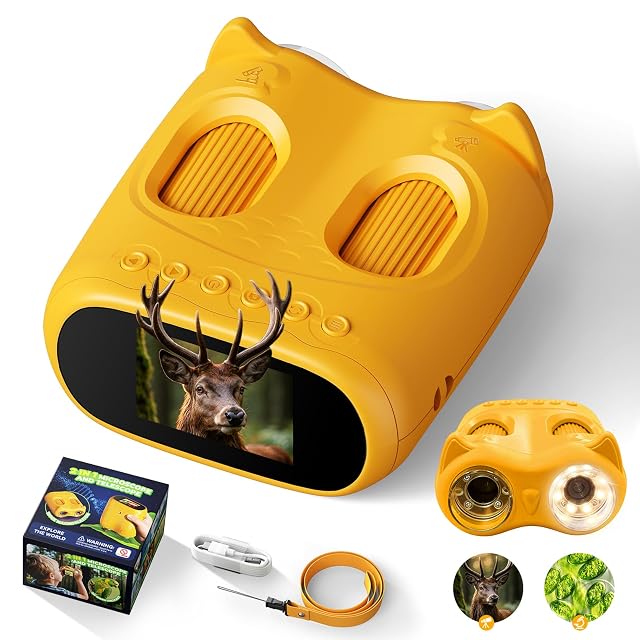
1000x hand microscope · 10x telescope · digital, 1080p
A two-in-one STEM device for children: a 1000x digital hand microscope and a 10x telescope attachment, recording 1080p stills and video to a memory card.
Best for: A child interested in insects, leaves and stones, with occasional distant viewing