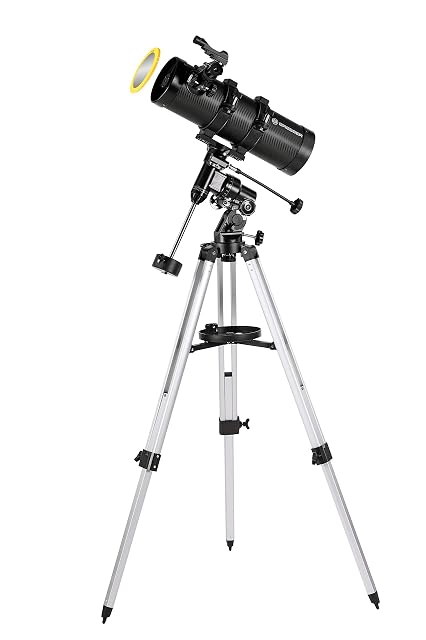
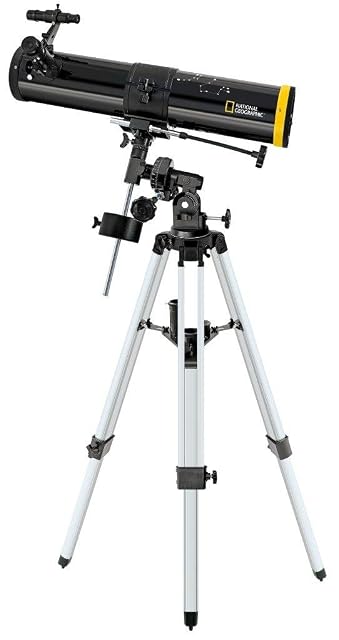
The bottom line A long-ratio 114 mm with a generous eyepiece set, carried by a mount at the limit of what the tube asks of it.
Aperture, focal length and the ratio between them
One hundred and fourteen millimetres and one thousand millimetres, giving f/8.8. That is the classic beginner’s Newtonian geometry: enough aperture to show the Moon in detail and the brighter planets as discs, and a ratio long enough that inexpensive eyepieces still behave.
Four eyepieces is a real advantage
Most sets ship with two. Four, plus a 2x Barlow, means the magnification steps are already covered and the next purchase can be a better diagonal or a filter rather than more glass. Whether any single one of them is excellent is another question, and the listing does not publish their designs.
Where the 500x claim comes from
The shortest supplied eyepiece with the Barlow. It is arithmetic, and the aperture cannot support it — past its resolving limit a telescope enlarges a blur. The figures at the top of this page are the ones that describe the instrument.
The mount is the compromise
An EQ-1 under a 1000 mm tube is working hard. It will track once aligned, and it will also transmit every touch of the focuser into the view. Damping time, not optical quality, is what will decide how high a magnification this set can actually hold.
Availability
German, French and Italian Amazon stores ran from 259 € to 336 € on the day of the survey.
British Amazon store lists it in local currency, which the euro range above sets aside.
Spanish Amazon catalogue holds a record for it that nobody is selling.
American Amazon store gave no result whatever, so the buy button there opens a search rather than an empty page.
Figures as Keepa reported them on the day this page was last updated. Stock and pricing shift without warning.
Prices quoted in this text were read on 17 September 2026. The live price is at the top of the page.
What it publishes, and what it withholds
Strengths
f/8.8 is forgiving of simple eyepieces and shows less coma at the field edge
Four eyepieces plus a Barlow is an unusually broad supplied range
Flexible cables allow fine adjustment without touching the tube
Compromises
The EQ-1 is the lightest mount in the equatorial series, and a 1000 mm tube is a long lever on it
The maker advertises magnification “up to 500x”, which a 114 mm cannot usefully deliver
No transmission figure is published for the supplied Moon filter
Specifications
Aperture
114 mm (title and bullet agree)
Focal length and ratio
1000 mm (title and bullet agree) · f/8.8, the quotient of the two figures above
Optical design
Newtonian reflector
Mirror coating
Not published by the maker.
Secondary obstruction
Not published by the maker.
Focuser type
Not published by the maker.
Tube length
Not published by the maker.
Collimation access
Not published by the maker.
Mount supplied
EQ-1 equatorial with flexible slow-motion cables
Supplied accessories
Four, per the maker · 2x Barlow, 5x24 finder, Moon filter, aluminium tripod with accessory tray
Amazon reference
B0CFF4JP29 (same reference on 5 Amazon marketplaces)
EAN
4000461102332
What observers ask about this one
Is 500x achievable?
It is arithmetically reachable with the shortest eyepiece and the Barlow. The optical ceiling for a 114 mm is conventionally put near twice the aperture in millimetres, and the air is usually the lower limit anyway.
Is the EQ-1 enough mount?
It is the lightest of the equatorial series, and the tube here is a metre long. Expect to wait for vibration to settle after every touch, which is the practical meaning of an undersized mount.
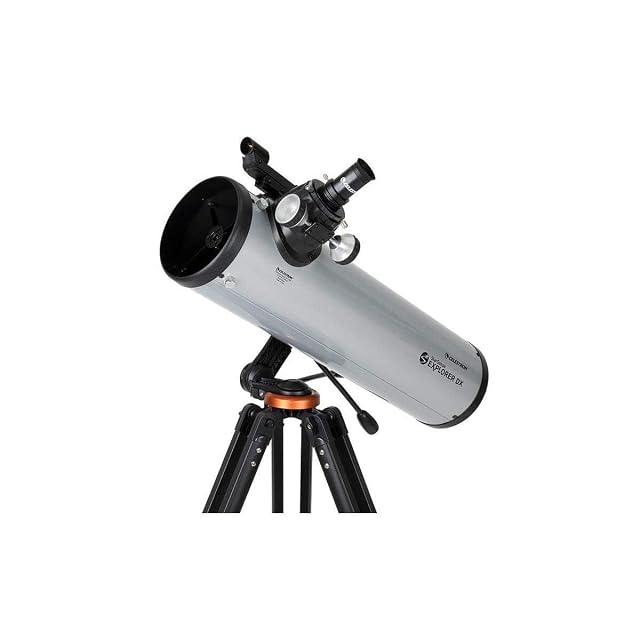
A 130 mm Newtonian on a manual alt-azimuth mount whose dock and app read the star field through the phone camera and steer the observer to a target with on-screen arrows.
Best for: A beginner who wants to see things this month rather than learn to star-hop first