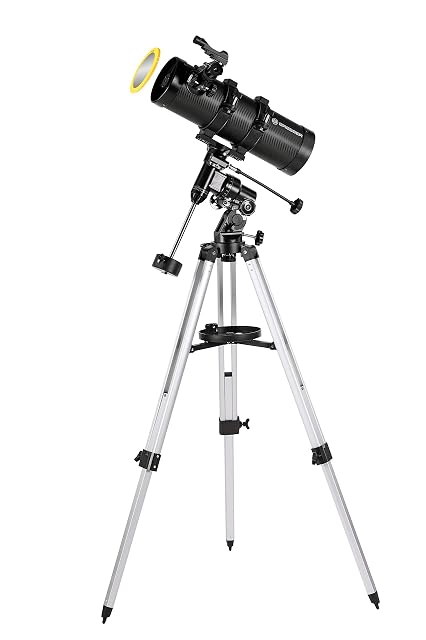
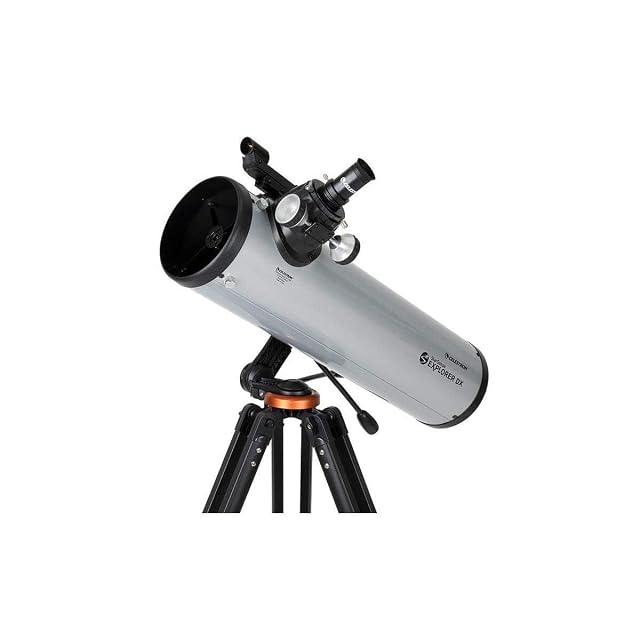
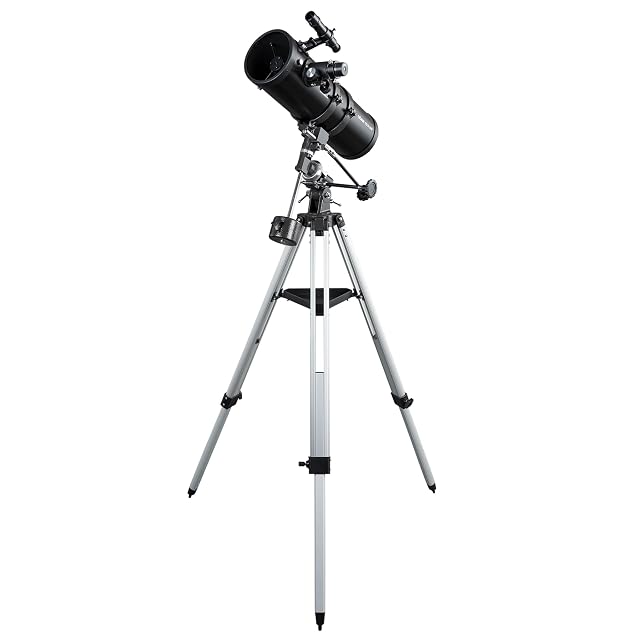
The bottom line The most capable deep-sky optic in this group, and the one that asks the most of its owner in return.
A fast parabola, stated plainly
One hundred and thirty millimetres at f/5, with the primary described as parabolic. That combination is what makes a wide field sharp at a fast ratio, and it is a specification worth having in writing — plenty of listings at this price say nothing about the mirror’s figure at all.
The focuser is the other honest detail
A 1.25 in focuser, with the maker saying outright that accessories from other manufacturers fit. That is the modern fitting, and it is what turns a telescope into a system rather than a sealed product.
Collimation is not optional here
At f/5 a small misalignment is visible as soft, flared stars across the field. The maker states that the mirrors are fully adjustable; a collimation tool is the purchase that goes with this telescope, not an optional extra.
What the mount adds
An EQ-320 with a tracking drive. Aligned on the pole, it keeps a target in the field while the eye does the work. The listing publishes no payload figure, which is the number that would say how much imaging weight it could carry — and this page will not supply one from elsewhere.
Availability
German, French, Italian and Spanish Amazon stores ran from 409 € to 415 € on the day of the survey.
American and British Amazon catalogues hold a record for it that nobody is selling.
Figures as Keepa reported them on the day this page was last updated. Stock and pricing shift without warning.
Prices quoted in this text were read on 17 September 2026. The live price is at the top of the page.
What it publishes, and what it withholds
Strengths
A parabolic primary is stated outright rather than left to be assumed
f/5 with 130 mm gives a genuinely wide, bright low-power field
The maker names the focuser size and says other brands’ accessories fit
Compromises
f/5 demands accurate collimation and rewards better eyepieces at the field edge
No payload figure is published for the EQ-320 in this listing
The tube is a full-length Newtonian, so storage is bulkier than a folded design
Specifications
Aperture
130 mm (from the title)
Focal length and ratio
650 mm (from the title) · f/5, the quotient of the two figures above
Optical design
Newtonian reflector with parabolic primary, stated by the maker
Mirror coating
Not published by the maker.
Secondary obstruction
Not published by the maker.
Focuser type
1.25 in, described as compatible with other makers’ accessories
Tube length
Not published by the maker.
Collimation access
Fully adjustable, stated by the maker
Mount supplied
EQ-320 equatorial with tracking gear
Supplied accessories
Illuminated LED
Amazon reference
B081SQFWGT (same reference on 6 Amazon marketplaces)
EAN
4049467610229
What observers ask about this one
Why does a parabolic mirror matter?
A spherical mirror at a fast ratio does not bring all the light to one point; a parabola does. At f/5 the difference is visible, which is why the maker states it.
What does the tracking gear do?
It drives the right ascension axis so an aligned mount follows the sky. It makes high magnification usable without constant nudging — and it depends entirely on the polar alignment being done first.
A 130 mm Newtonian on a manual alt-azimuth mount whose dock and app read the star field through the phone camera and steer the observer to a target with on-screen arrows.
Best for: A beginner who wants to see things this month rather than learn to star-hop first