The bottom line Aperture and a forgiving focal ratio in the same tube, at the cost of length and of a mount the listing does not name.
An aperture and a ratio that rarely travel together
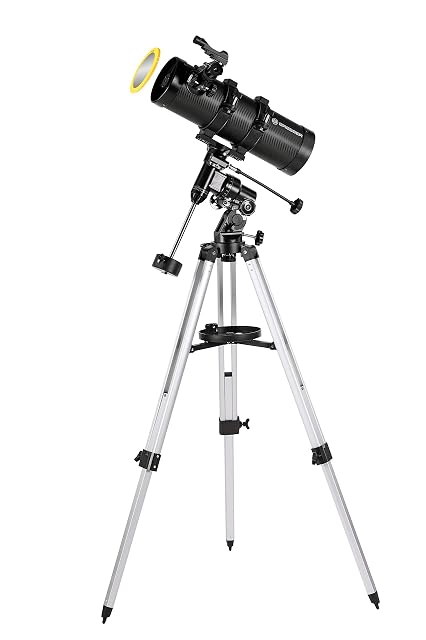
Most 150 mm Newtonians are fast — f/5 or thereabouts — because that keeps them short. This one is 1400 mm long, which works out at f/9.3. The gain is real: eyepieces behave better, edge aberrations are milder, and the same eyepiece delivers more magnification than it would in a short tube.
What the length costs
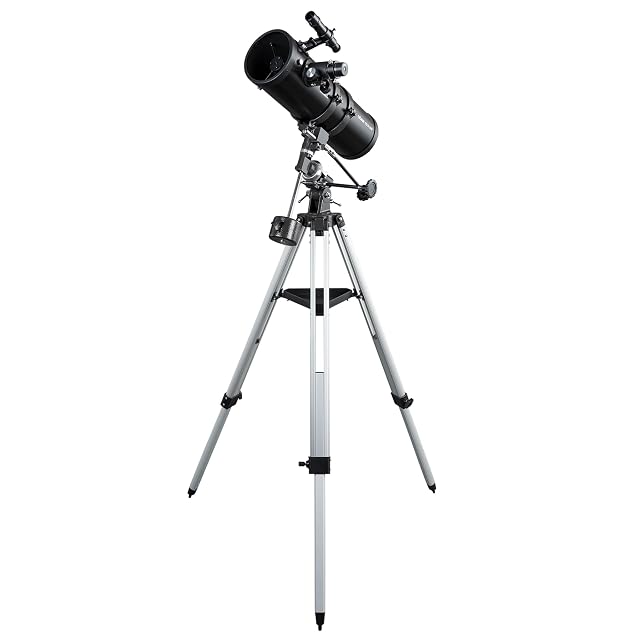
Handling. A 1400 mm tube is a substantial object on an equatorial head, and the focuser swings through a wide arc as the telescope tracks. Neither is a fault; both decide whether the telescope gets carried outside on a Tuesday.
The supplied accessories, as stated
Several eyepieces, a finder, a Barlow and a Moon filter. The Moon filter has no transmission figure attached in the listing, which is the usual state of affairs and the reason this site keeps saying so.
Collimation still applies
Every Newtonian needs its mirrors aligned. A long ratio is more tolerant of a small error than a fast one, which makes this a gentler introduction to the routine — not an exemption from it.
Availability
German, French, Italian and Spanish Amazon stores ran from 190 € to 197 € on the day of the survey.
British Amazon catalogue holds a record for it that nobody is selling.
American Amazon store gave no result whatever, so the buy button there opens a search rather than an empty page.
Figures as Keepa reported them on the day this page was last updated. Stock and pricing shift without warning.
Prices quoted in this text were read on 17 September 2026. The live price is at the top of the page.
What it publishes, and what it withholds
Strengths
A 150 mm mirror at f/9.3 is an unusual combination — big aperture with a forgiving ratio
The long focal length suits the Moon and planets without needing short eyepieces
Sold as a complete set, so nothing else is required for a first night
Compromises
A 1400 mm Newtonian is a long tube, and the eyepiece ends up high when pointed low
No transmission figure is published for the supplied Moon filter
The maker does not state the mount model, only that one is included
Specifications
Aperture
150 mm (from the title)
Focal length and ratio
1400 mm (from the title) · f/9.3, the quotient of the two figures above
Optical design
Newtonian reflector
Mirror coating
Not published by the maker.
Secondary obstruction
Not published by the maker.
Focuser type
Knurled focuser knob, stated by the maker
Tube length
Not published by the maker.
Collimation access
Not published by the maker.
Mount supplied
Equatorial, supplied with tripod
Supplied accessories
Several eyepieces, finder, Barlow lens, Moon filter
Amazon reference
B00PZLPH1Q (same reference on 5 Amazon marketplaces)
EAN
4049467453185
What observers ask about this one
Is f/9.3 unusual for a Newtonian?
It is longer than most at this aperture, and it has a real consequence: simple eyepieces perform better at long ratios, and coma at the edge of the field is less obvious.
How does the length affect use?
A 1400 mm tube puts the focuser a long way from the mount. Pointed near the horizon, that means a high eyepiece; pointed at the zenith, a low one. A seat with adjustable height earns its place here.
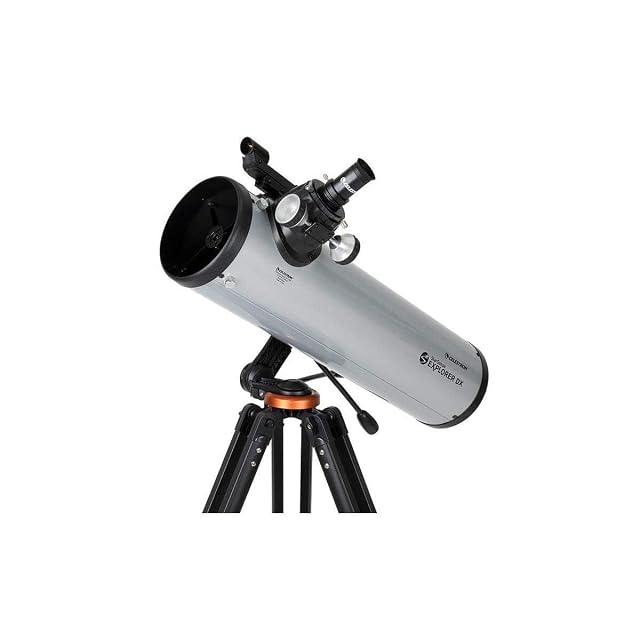
A 130 mm Newtonian on a manual alt-azimuth mount whose dock and app read the star field through the phone camera and steer the observer to a target with on-screen arrows.
Best for: A beginner who wants to see things this month rather than learn to star-hop first