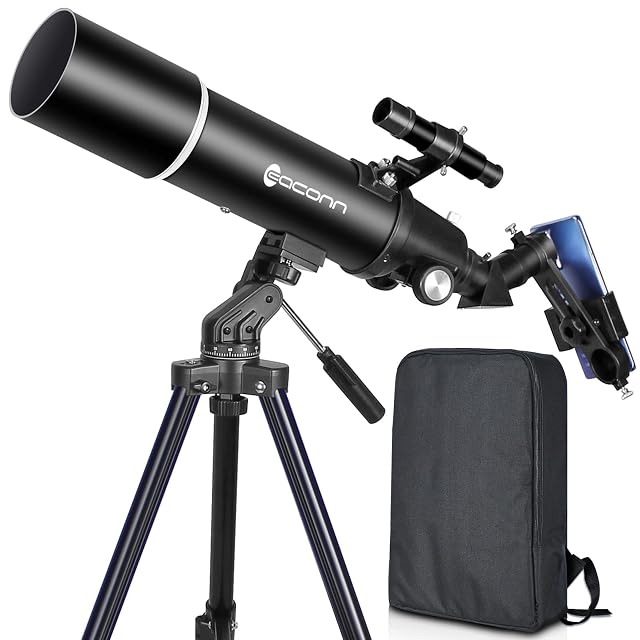
The bottom line A modern-fitting 70 mm whose own listing cannot agree on its focal length — worth checking the tube before ordering an eyepiece.
A contradiction worth naming
The title describes the instrument as 70 mm at f/700; one of the supplied-items bullets describes a 70 mm f/900 refractor. Both come from the same listing. That difference changes every magnification the set produces, and it is exactly the sort of figure this site refuses to average or to guess. Read the tube.
The fitting is right
Everything supplied is 1.25 in: the two eyepieces, the diagonal, the Barlow. That is the size the whole modern accessory market is built on, and it is the difference between a telescope that can be improved and one that is finished on the day it arrives.
Four magnifications, and where they come from
Two eyepieces with a 2x Barlow give four combinations, which is what the maker’s magnification list counts. Divide whichever focal length proves correct by 25 and by 10, then halve the eyepiece figure for the Barlow. The arithmetic belongs to the reader.
The light-grasp claim
The maker states 36 % more light than a 60 mm. That is the ratio of the two areas, and it is true of any 70 mm compared with any 60 mm. It says nothing specific about this objective.
Availability
German, French, Italian and Spanish Amazon stores ran from 171 € to 193 € on the day of the survey.
American and British Amazon catalogues hold a record for it that nobody is selling.
Figures as Keepa reported them on the day this page was last updated. Stock and pricing shift without warning.
Prices quoted in this text were read on 17 September 2026. The live price is at the top of the page.
What it publishes, and what it withholds
Strengths
The 1.25 in eyepiece fitting is the modern one, so upgrades exist
A Barlow and two eyepieces give four magnifications out of the box
Multi-coated objective is stated by the maker rather than implied
Compromises
The listing contradicts itself on focal length, and no third source settles it
A 6x24 finder is small, though larger than the 5x24 on cheaper sets
The four magnifications the maker prints depend entirely on the supplied eyepieces
Specifications
Aperture
70 mm (title and bullet agree)
Focal length and ratio
The title says f/700; a supplied-items bullet says 70 mm f/900 — both are reproduced here, neither is chosen
Lens design
Refractor, multi-coated objective per the maker’s bullet
Glass type
Not published by the maker.
Focuser
Not published by the maker.
Drawtube
Not published by the maker.
Tube weight
Aluminium
Supplied accessories
10 mm and 25 mm, 1.25 in · 6x24 · 2x Barlow, 1.25 in star diagonal, alt-azimuth mount, aluminium tripod with accessory tray
Amazon reference
B0017GXFXU (same reference on 6 Amazon marketplaces)
EAN
4049467050001
What observers ask about this one
Which focal length is right?
The listing gives both 700 mm and 900 mm in different places. This page reports the contradiction rather than resolving it; the figure printed on the tube or in the manual is the one to trust.
What does the 1.25 in fitting change?
Everything about what comes next. That is the size almost every modern eyepiece, filter and diagonal is made in, so the telescope can be improved rather than replaced.
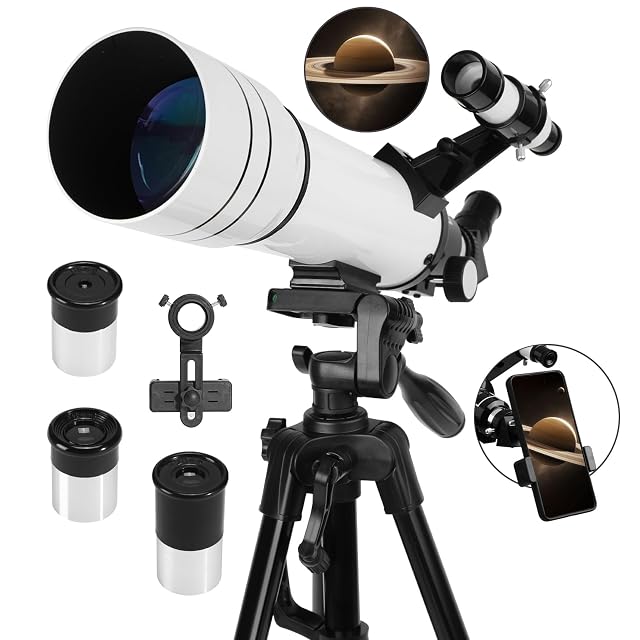
A 70/400 refractor sold with two eyepieces, a 5x Barlow, a phone adapter and a stainless-steel tripod — and a listing whose own bullets contradict its title.
Best for: A buyer who will check the tube’s printed figures before ordering anything else for it
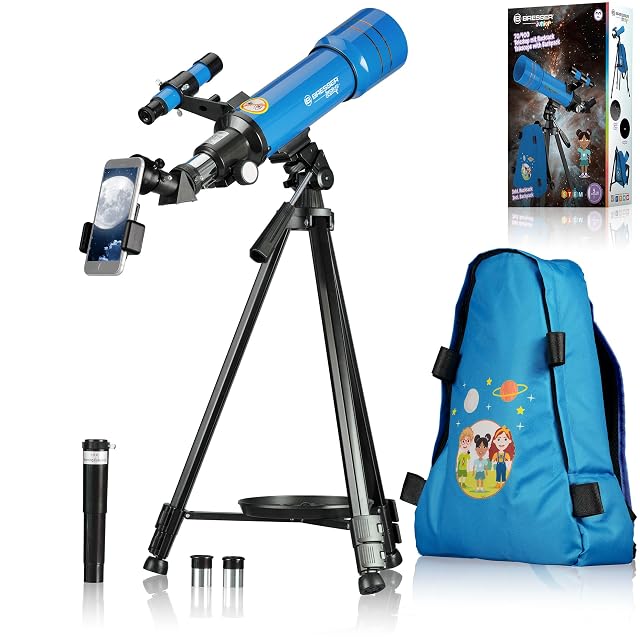
A 70/400 refractor sold as a first instrument for children from eight, supplied in a backpack with three eyepieces, a star diagonal and an erecting lens.
Best for: A child from about eight who will carry the telescope themselves