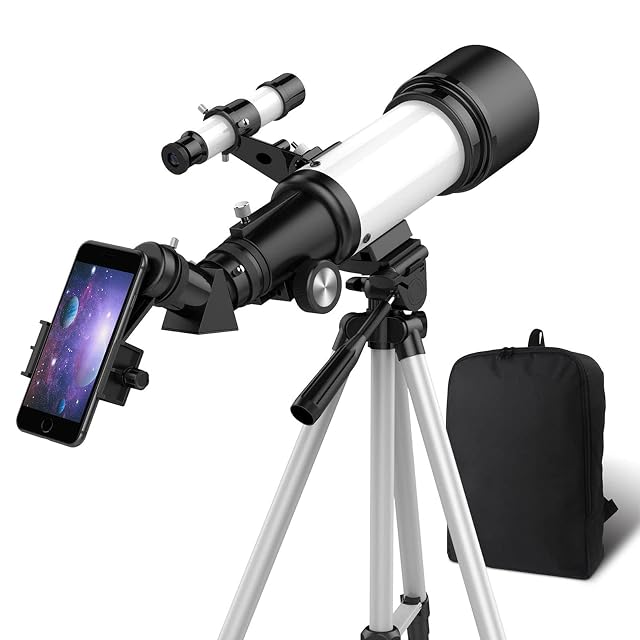
The bottom line A thoughtfully equipped travel set whose numbers mostly add up, with a diagonal chosen for the ground rather than the sky.
The arithmetic checks out
Four hundred divided by twenty-five is sixteen; four hundred divided by six is sixty-seven. Those are exactly the magnifications the maker quotes for the two supplied eyepieces, which is a small thing and a reassuring one — plenty of listings on this shelf quote figures that do not follow from their own specifications.
Where a claim floats free
Ninety-nine and a half per cent transmission, with no wavelength attached. Coating performance varies across the spectrum, and a percentage without a band is a number that cannot be compared with anything. It is reported here because the maker publishes it, not because it can be checked.
The diagonal tells you the design intent
Forty-five degrees is the terrestrial angle. Combined with the erecting function and the shutter release, this is a set built at least as much for landscapes and daytime photography as for the sky. For objects high overhead, a 90° diagonal would be the addition to make.
The tripod figure worth having
Forty to ninety centimetres. That range decides whether a child can use it standing and an adult can use it seated, and publishing both ends is more useful than the word “adjustable” ever is.
Availability
German, French, Italian and Spanish Amazon stores ran from 55 € to 84 € on the day of the survey.
British Amazon store lists it in local currency, which the euro range above sets aside.
American Amazon store gave no result whatever, so the buy button there opens a search rather than an empty page.
Figures as Keepa reported them on the day this page was last updated. Stock and pricing shift without warning.
Prices quoted in this text were read on 17 September 2026. The live price is at the top of the page.
What it publishes, and what it withholds
Strengths
Tripod height range is published as two figures rather than described as “adjustable”
A shutter release is included, which is the accessory that stops phone photos shaking
The magnifications quoted match the arithmetic exactly: 400 divided by 25 and by 6
Compromises
A 99.5 % transmission claim is published without naming the wavelength it applies to
A 45° diagonal is comfortable for landscapes and awkward for anything near the zenith
No transmission figures are given for the four Moon filters
Specifications
Packed length
400 mm (maker’s bullet)
Total carried weight
Not published by the maker.
Aperture
70 mm (maker’s bullet)
Focal ratio
f/5.7, the quotient of the two figures above
Optical design
Refractor, fully multi-coated per the maker
Mount
Not published by the maker.
Tripod type
Aluminium, 40 cm to 90 cm, as the maker publishes it
Case protection
K25 and K6, giving 16x and 67x per the maker · Four Moon filters, shutter release, phone adapter, backpack, 5x24 finder
Setup time
Not published by the maker.
Amazon reference
B07WC39H5M (same reference on 5 Amazon marketplaces)
EAN
0639510677329
What observers ask about this one
Why is a 45° diagonal a compromise?
It puts the eyepiece at a comfortable angle for horizontal viewing, which suits landscapes. Pointed high, it forces the head into an awkward position — a 90° diagonal is the usual astronomical choice.
What do four Moon filters do?
They cut brightness by different amounts. Without published transmission percentages there is no way to compare them with any other filter, which is the recurring problem on this shelf.
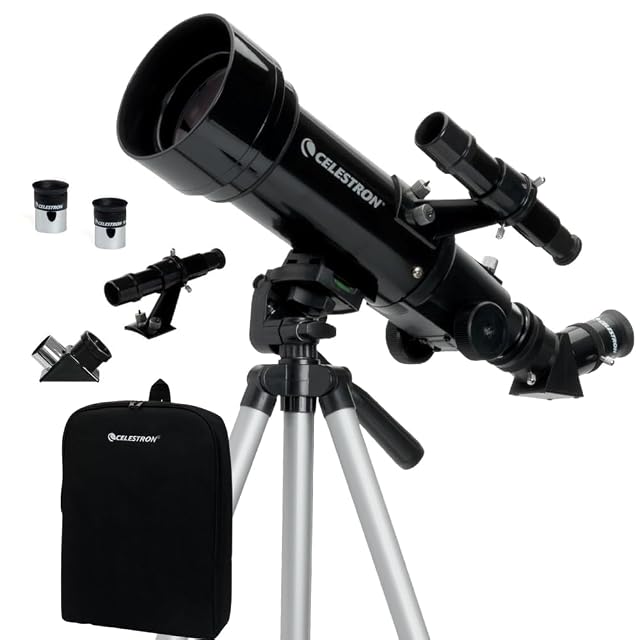
A 70 mm travel refractor sold with a backpack, a full-height tripod, two eyepieces, and — in this Amazon-exclusive version — an extra 4 mm eyepiece and a 3x Barlow.
Best for: A 70 mm that travels with a proper tripod rather than a tabletop stand
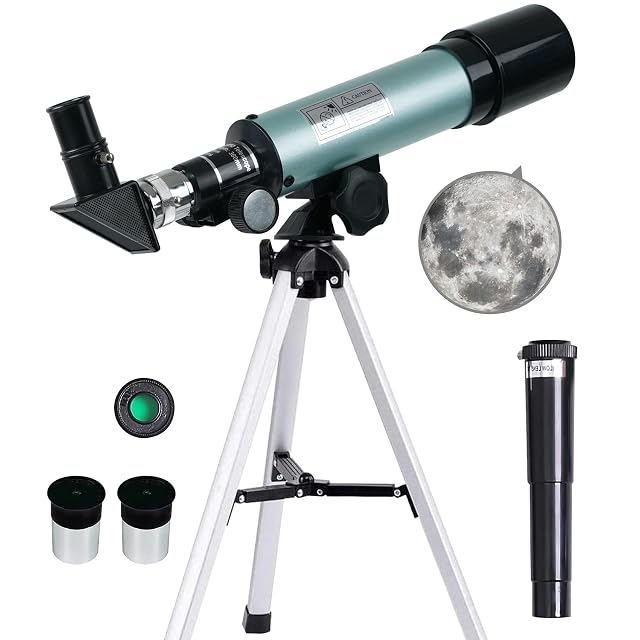
A 50/360 refractor for children and beginners, supplied with two eyepieces, a 1.5x erecting lens, a Moon filter and a folding tripod that packs into a bag.
Best for: A child’s first telescope that has to fit in hand luggage