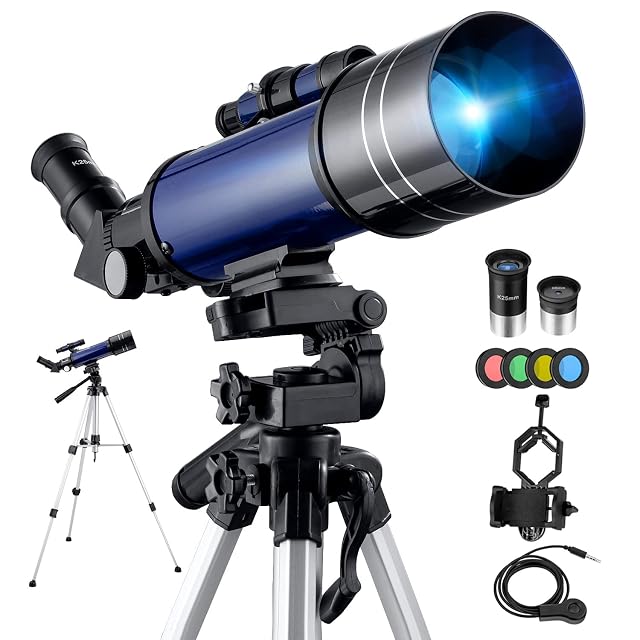
The bottom line A clearly specified small refractor let down by one line of advertising copy that has lost its meaning in translation.
What the maker gets right
Aperture, focal length and focal ratio all published, and the ratio agrees with the other two. Eyepieces named with their focal lengths and their barrel size. Magnifications quoted that follow from the arithmetic. That is a better-documented listing than most of this shelf.
And the line that fell apart
Where the finder should be described, the listing reads “12.7 x 61 cm”. No finder has those dimensions, and the figure cannot be reconciled with anything else in the advertisement. It is reported here as it stands.
The fitting is the future-proofing
Both eyepieces are 1.25 in. That means a better eyepiece, a nebula filter, a Barlow or a proper diagonal can all be added later — the single most important thing to check before buying at this price, and the thing cheap sets most often get wrong.
The erecting prism
It delivers an upright image for daytime use and costs a little light. For the sky it is a convenience rather than a requirement; a 90° star diagonal is the more comfortable choice for anything high overhead.
Availability
German Amazon store sat at about 60 € on the day of the survey.
American, British, French, Italian and Spanish Amazon catalogues hold a record for it that nobody is selling.
Figures as Keepa reported them on the day this page was last updated. Stock and pricing shift without warning.
Prices quoted in this text were read on 17 September 2026. The live price is at the top of the page.
What it publishes, and what it withholds
Strengths
The maker publishes the focal ratio directly instead of leaving it to be calculated
Eyepieces are stated as 1.25 in, so the whole modern accessory range fits
Quoted magnifications match the arithmetic on the published focal length
Compromises
The finder is described as “12.7 x 61 cm”, which is not a finder specification in any reading
A fast achromat at f/5.7 shows colour on the brightest targets
The phone adapter is described for a 10 mm eyepiece the specification list does not include
Specifications
Packed length
400 mm, stated by the maker as f/5.7
Total carried weight
Not published by the maker.
Aperture
70 mm (maker’s bullet)
Focal ratio
f/5.7, published by the maker and consistent with the two figures
Optical design
Refractor, fully multi-coated per the maker
Mount
Not published by the maker.
Tripod type
Not published by the maker.
Case protection
K20 mm and K9 mm, 1.25 in, giving 20x and 44x per the maker · Phone adapter for the 10 mm position, adjustable tripod, carry bag
Setup time
Not published by the maker.
Amazon reference
B088KRWG5K (same reference on 6 Amazon marketplaces)
EAN
0727380311877
What observers ask about this one
What is the finder?
The listing gives “12.7 x 61 cm” where a finder specification should be, which describes nothing. Finders on telescopes of this class are typically 5x24; the figure in the advertisement cannot be read as one.
Does the 1.25 in fitting matter?
It is the difference between a telescope that can be improved and one that cannot. Every modern eyepiece, filter and diagonal is made in that size, and the maker states it here.
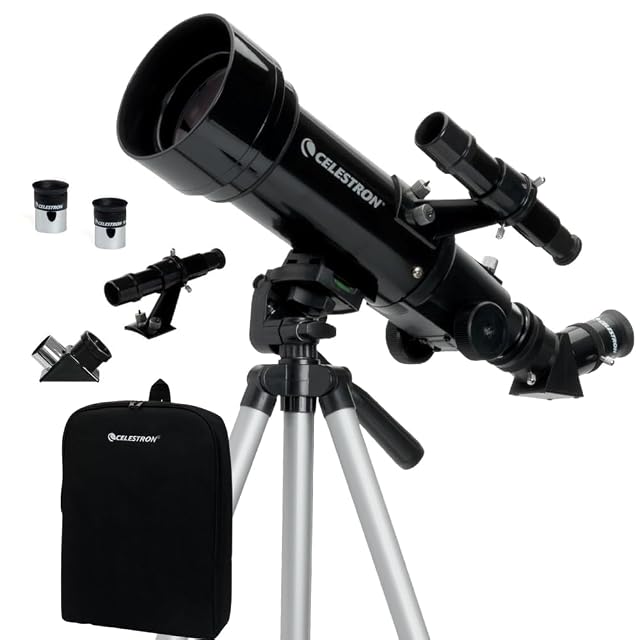
A 70 mm travel refractor sold with a backpack, a full-height tripod, two eyepieces, and — in this Amazon-exclusive version — an extra 4 mm eyepiece and a 3x Barlow.
Best for: A 70 mm that travels with a proper tripod rather than a tabletop stand
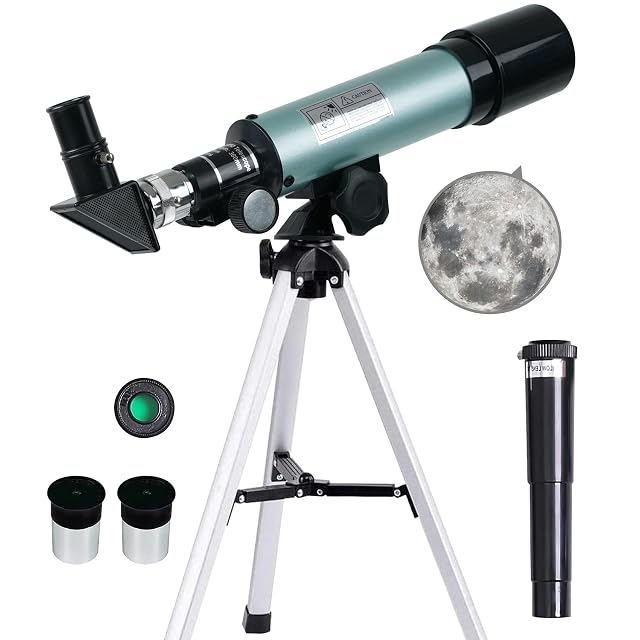
A 50/360 refractor for children and beginners, supplied with two eyepieces, a 1.5x erecting lens, a Moon filter and a folding tripod that packs into a bag.
Best for: A child’s first telescope that has to fit in hand luggage