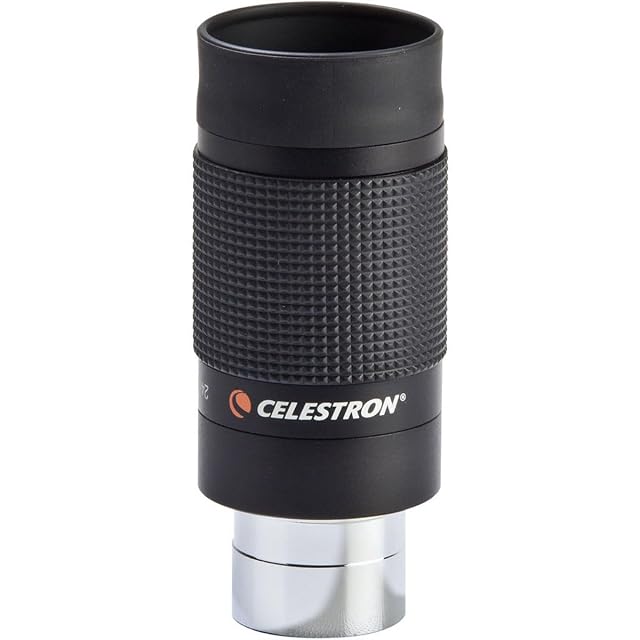
The bottom line A cheaper zoom with a usefully short end, and a listing that manages to advertise a defect.
The range is the difference
Seven to twenty-one, against the eight to twenty-four of its neighbours. That reaches slightly higher magnification and gives up some of the wide end — a sensible trade on a long telescope and the wrong one on a short refractor, where the wide setting is what finds things.
The claim that reads backwards
One bullet lists “high dispersion” among the eyepiece’s qualities. Dispersion is the property that separates wavelengths and produces colour fringing; every optical design on this shelf spends money reducing it. The claim almost certainly began life as “low dispersion” and did not survive translation.
What is published
The range, the barrel size, a metal body and a fully multi-coated claim. What is not: apparent field at either end, eye relief, weight, element count.
Using a zoom well
Find at the wide setting, then zoom in on the object while it is centred. That is the same discipline a fixed set imposes by forcing an eyepiece change, and a zoom makes it painless.
Availability
British Amazon store held a record for it on the day of the survey, with no euro figure against the offer.
German, Italian and Spanish Amazon catalogues hold a record for it that nobody is selling.
American and French Amazon stores gave no result whatever, so the buy button there opens a search rather than an empty page.
Figures as Keepa reported them on the day this page was last updated. Stock and pricing shift without warning.
What it publishes, and what it withholds
Strengths
A shorter range than the 8–24 zooms, reaching 7 mm for planetary work
A metal body rather than a plastic one at this price
Fully multi-coated is claimed, which is the strongest of the four labels
Compromises
A bullet advertises high dispersion as though it were a benefit
No apparent field is published at either end of the range
No eye relief, weight or element count appears
Specifications
Focal length range
7 mm to 21 mm, continuously variable
Apparent field at both ends
Not stated; described only as wide
Eye relief
Not published by the maker.
Parfocality
Not published by the maker.
Action
Not published by the maker.
Stops
Not published by the maker.
Barrel size
1.25 in (31.7 mm)
Coatings
Fully multi-layer coated, as the maker words it
Body
Metal
Amazon reference
B08DKW6SLW (same reference on 4 Amazon marketplaces)
EAN
8475894973358
What observers ask about this one
What is wrong with “high dispersion”?
Dispersion is what splits light into colours, and controlling it is the whole purpose of ED glass and achromatic designs. Advertising it as a feature almost certainly reflects a translation that reversed the meaning of a claim about low dispersion.
How does 7–21 compare with 8–24?
It reaches one millimetre shorter at the top of the magnification range and stops three millimetres shorter at the wide end. On a long-focal-length telescope that trade favours planetary work.
8–24 mm variable · 40°–60° apparent field · 1.25 in
An 8–24 mm zoom eyepiece in a 1.25 in barrel, multi-coated, with a fold-down eyecup and an apparent field running from 40 to 60 degrees across the range.
Best for: Observers who want to stop swapping eyepieces in the cold
114 mm mirror · 900 mm focal length · alt-azimuth mount
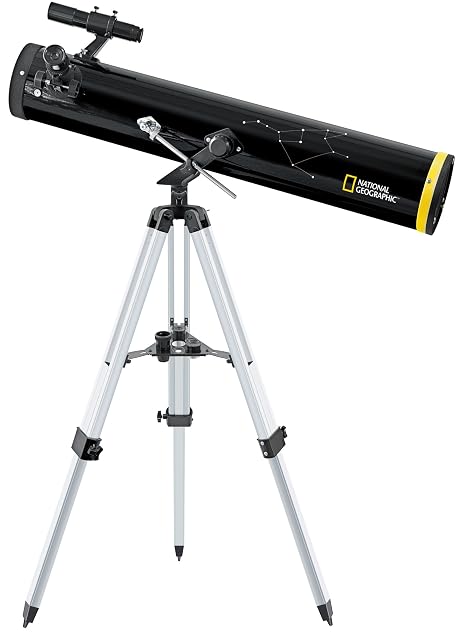
A 114/900 Newtonian on a simple alt-azimuth mount, supplied with three eyepieces, a 6x30 finder and a 1.5x erecting lens, recommended by the maker from age eight.
Best for: A family telescope where nobody wants to learn polar alignment
Any figure written into the body of this page was true on the day it was written. The amount shown next to each instrument is requested from the retailer as the page loads, and it is that amount, not the text, that stands.