No eyepiece at all — a sensor, a phone and a stack · review
Bresser PushTo AR 80/400 review
An 80/400 refractor whose built-in sensors report where it is pointing to a free phone app, which then guides the observer to a target with on-screen arrows.
The bottom line The cheapest honest answer to “I cannot find anything”: a plain 80 mm refractor with sensors that turn a phone into a guide rather than a driver.
Two figures, then the clever part
Eighty millimetres of aperture and four hundred of focal length — f/5. That is a wide, bright, short instrument, which is exactly the right geometry for a telescope aimed by hand: the low-power field is large enough to catch a target that the app puts you merely close to.
What PushTo actually is
Sensors inside the mount measure where the tube is pointing and send that over Bluetooth to a free app. The app draws arrows; you push. Nothing motorised moves, nothing tracks, and no plate-solving happens. It is the least expensive way to remove the beginner’s real obstacle, which has never been optics.
The slip clutches matter
Without them, a mount that reports its position has to be moved carefully. With them, the tube swings freely under the hand and the sensors keep up. That is the difference between a gadget and a usable telescope.
Power, and the winter problem
AA cells or USB-C. A cold night flattens a power bank quickly, and a set of alkaline cells in a pocket is the backup that keeps the app alive. It is a small specification and a real one.
Availability
German Amazon store sat at about 259 € on the day of the survey.
American, British, French, Italian and Spanish Amazon catalogues hold a record for it that nobody is selling.
Figures as Keepa reported them on the day this page was last updated. Stock and pricing shift without warning.
Prices quoted in this text were read on 17 September 2026. The live price is at the top of the page.
What it publishes, and what it withholds
Strengths
Sensors read position rather than the phone camera, so the app works without a clear plate-solve
Slip clutches mean the tube can be swung by hand and the app keeps up
Runs on AA cells as well as USB-C, which matters when a power bank dies in the cold
Compromises
PushTo guides but does not drive: every movement is made by hand
f/5 on an achromat is the combination that shows colour most readily on bright targets
A compass is supplied, and a compass near a steel tripod is not a precise instrument
Specifications
Aperture
Achromatic refractor · 80 mm (maker’s bullet)
Sensor
Not published by the maker.
Pixel size
Not published by the maker.
Field of view
Not published by the maker.
Plate-solving
Built-in sensors reporting over Bluetooth to the free PushTo app
Tracking
Alt-azimuth with slip clutches for free movement, per the maker
Stacking behaviour
Not published by the maker.
Battery life
AA cells or USB-C, as the maker states it
File export
Not published by the maker.
Amazon reference
B0H8QWCS13 (same reference on 6 Amazon marketplaces)
EAN
4007922205380
What observers ask about this one
How does this differ from a camera-based app system?
Sensors in the mount report its orientation directly, so nothing has to be photographed and solved. The trade is that the system knows where it points only as accurately as its initial reference, where a camera-based one re-checks against the sky itself.
Does it track?
No. Slip clutches let you swing the tube freely and the app follows along, but the sky drifts and you correct it by hand. What is automated is finding.
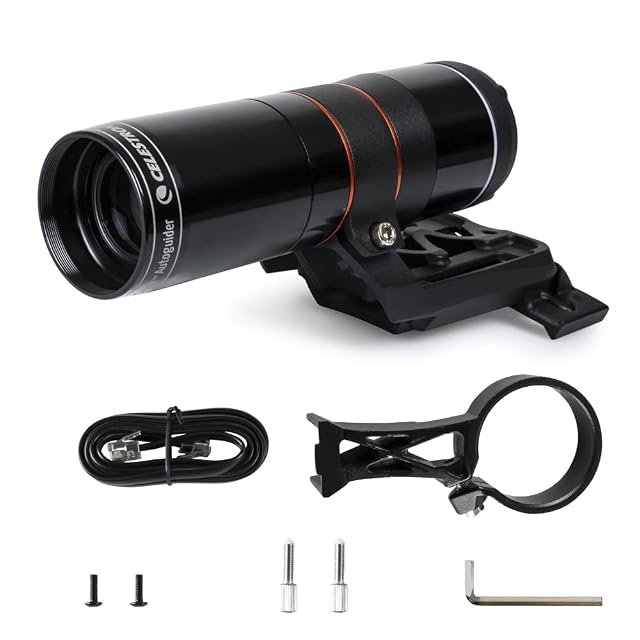
An accessory that bolts to a computerised Celestron mount and aligns it on the sky automatically in about three minutes, then improves its pointing and assists polar alignment.
Best for: An owner of a computerised Celestron mount who is tired of three-star alignments
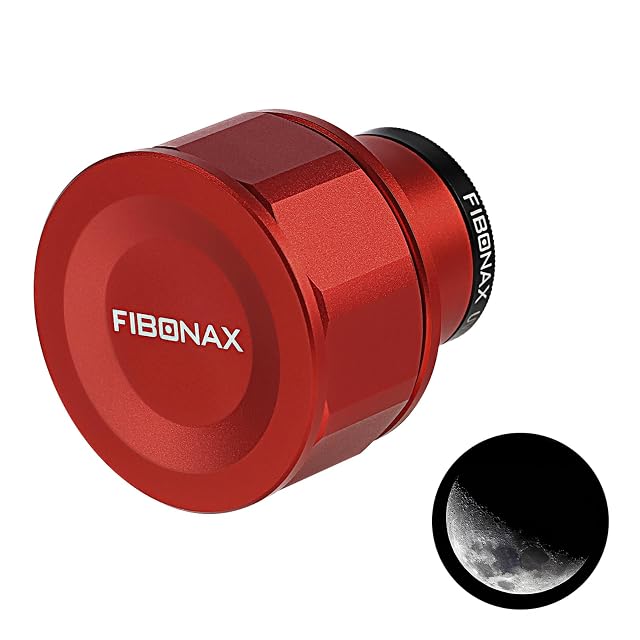
An 8 MP electronic eyepiece camera that replaces the eyepiece in a 1.25 in focuser and streams live video to a computer over USB, with an IR-cut filter fitted.
Best for: Lunar and planetary video, and showing a live view to more than one person at once
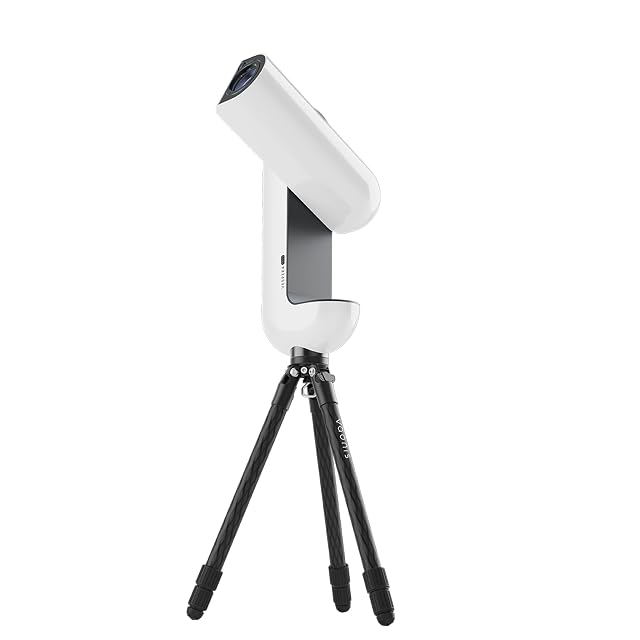
A self-contained imaging telescope with a Sony IMX676 sensor, an apochromatic flat-field quadruplet objective and an app that stacks exposures across several nights automatically.
Best for: Deep-sky imaging from a balcony or a garden, without a mount, a camera or a laptop