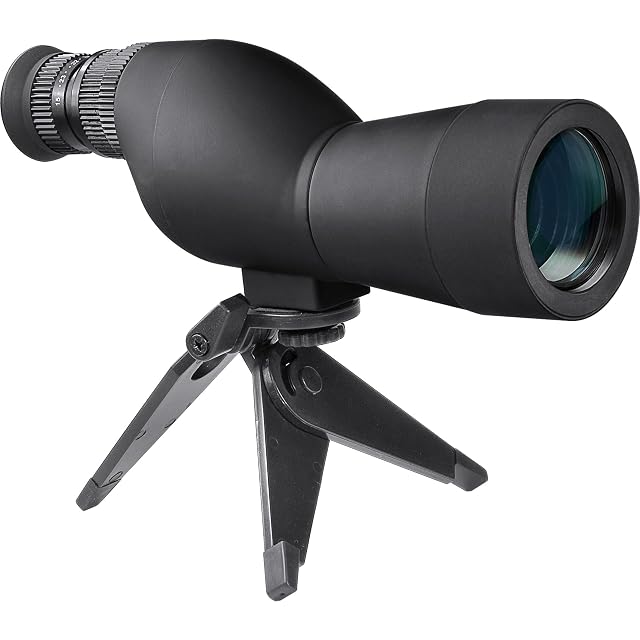
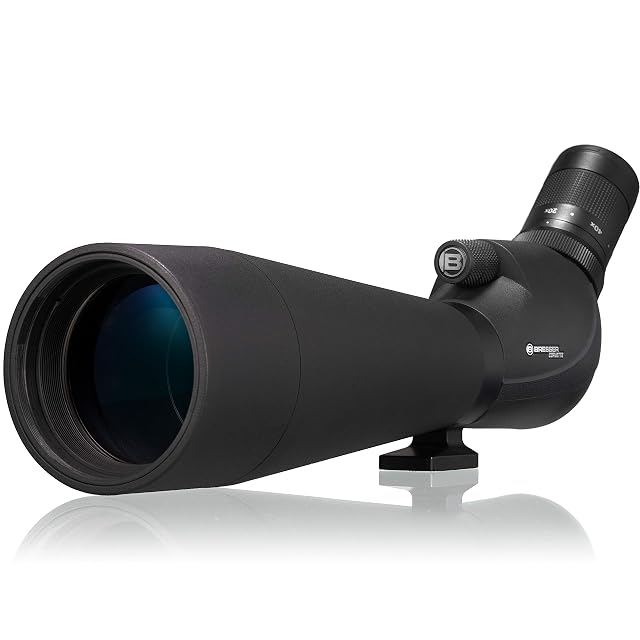
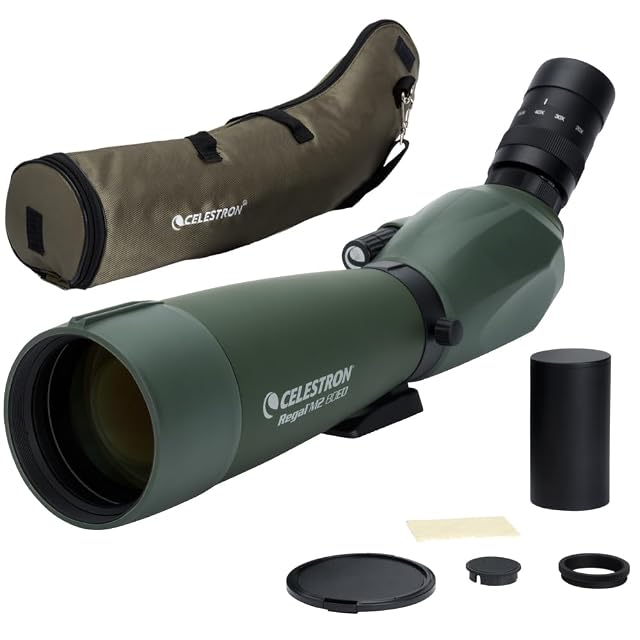
A 20–60x80 spotting scope with BAK4 porro prisms and fully multi-coated optics, supplied with a full-metal tabletop tripod, a phone adapter and a carry case.
The bottom line A well-equipped daytime scope whose published field of view has lost its meaning somewhere in translation.
What eighty millimetres gives at each end
Divided by twenty, the objective yields a 4 mm exit pupil — bright, comfortable, and usable at dusk. Divided by sixty it yields 1.3 mm, which is dim and demands that the eye sit exactly right. Every zoom spotting scope behaves this way, and knowing the arithmetic sets the expectation.
The accessories are the value
A full-metal tabletop tripod, a digiscoping adapter, a carry case, lens covers and a cleaning cloth. At this price that is a complete outfit, and the metal tripod in particular is a step above the plastic ones usually supplied.
The figure that does not parse
The second bullet offers “a field of view of 1000 metres”. Field of view is an angle: 2.06 degrees, or 36 metres at 1000 metres, or something of that form. What is printed cannot be read as either, and this page reports it rather than inventing a figure.
Where it stops being astronomical
The zoom eyepiece is built in. Without a 1.25 in barrel there is no way to fit a proper astronomical eyepiece, a nebula filter or a Barlow — which is the boundary between a spotting scope and a small telescope.
Availability
German, French, Italian and Spanish Amazon stores ran from 170 € to 219 € on the day of the survey.
British Amazon store lists it in local currency, which the euro range above sets aside.
American Amazon catalogue holds a record for it that nobody is selling.
Figures as Keepa reported them on the day this page was last updated. Stock and pricing shift without warning.
Prices quoted in this text were read on 17 September 2026. The live price is at the top of the page.
What it publishes, and what it withholds
Strengths
A full-metal tabletop tripod is supplied rather than a plastic one
Eighty millimetres of objective keeps the 20x end genuinely bright
Complete accessory set: adapter, case, covers and cloth all itemised
Compromises
The field of view is published as a distance, which describes nothing
At 60x the exit pupil falls to 1.3 mm, which is dim and hard to hold the eye in
The zoom eyepiece is not removable for an astronomical one
Specifications
Aperture
80 mm
Zoom range
20x to 60x, variable
Exit pupil
4 mm at 20x falling to 1.3 mm at 60x
True field of view
The listing states “a field of view of 1000 metres”, which is not an angular measurement
Body shape
Not published by the maker.
Glass type
BAK4 porro, per the maker
Coatings
Fully multi-coated with a green film
Close focus
Not published by the maker.
Focusing
Not published by the maker.
Sealing
Nitrogen-filled, waterproof and fog-proof per the maker
Weight
Not published by the maker.
Eyepiece fitting
Not a standard astronomical barrel — the zoom eyepiece is part of the instrument
B07VC7ZN6P (same reference on 6 Amazon marketplaces)
EAN
0634759544951
What observers ask about this one
Can a spotting scope be used on the night sky?
Yes, within limits. At the 20x end an 80 mm objective gives a 4 mm exit pupil, which shows the Moon well, Jupiter’s moons and bright clusters. What it lacks is a removable eyepiece and an equatorial mount.
What is wrong with the field figure?
Field of view is an angle, usually written as degrees or as metres at 1000 m. “A field of view of 1000 metres” is neither, and nothing in the listing supplies the missing half of the figure.
A waterproof 20–60x80 spotting scope with fully multi-coated optics, a 340° rotating body and a supplied tabletop tripod — published with its field of view, close focus, size and weight.
Best for: A buyer who wants to compare figures rather than adjectives before choosing
20–60x · 80 mm ED · 1.25 in eyepiece mount · magnesium body
An ED-glass 20–60x80 angled spotting scope in a magnesium alloy body, with XLT coatings, dual focus, a rotating tripod collar, a 1.25 in astronomical eyepiece mount and a T-adapter ring.
Best for: The observer who wants one instrument for birds by day and the Moon and planets by night