A camera, a lens and one motor against the rotation · review
Bresser Messier EXOS-2 EQ review
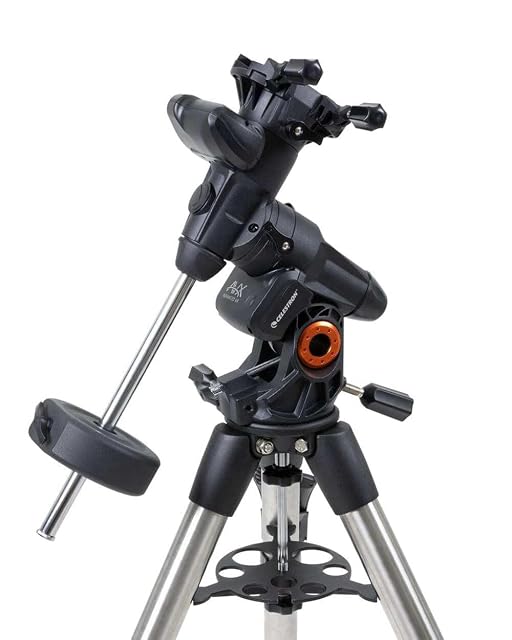
An equatorial mount head with radial ball bearings on both axes, a stated capacity of 13 kg, a polar finder and a 4.5 kg counterweight, on a height-adjustable aluminium tripod.
The bottom line A properly specified equatorial head that publishes its own weight as well as its capacity — which most do not.
Three numbers, all published
Thirteen kilograms of stated capacity, a 4.9 kg head, and a 4.5 kg counterweight in the box. Together those describe both what the mount will carry and what has to be carried to the garden, and it is unusual to find all three in one listing.
Bearings on both axes
Radial deep-groove ball bearings, named as such. That is what produces the smooth movement that makes slow-motion cables pleasant rather than notchy, and it is a specification rather than an adjective.
What comes with it
The head, a height-adjustable tripod, two flexible slow-motion cables, a polar finder and the counterweight. A polar finder included rather than sold separately is worth noting: it is the accessory that makes the equatorial geometry work.
The upgrade path
Two-axis motorisation with GoTo, available separately. Buying an unmotorised EXOS-2 and adding drives later is a reasonable route, and the maker says the option exists rather than leaving it to be discovered.
Availability
German, French, Italian and Spanish Amazon stores ran from 568 € to 597 € on the day of the survey.
British Amazon store lists it in local currency, which the euro range above sets aside.
American Amazon catalogue holds a record for it that nobody is selling.
Figures as Keepa reported them on the day this page was last updated. Stock and pricing shift without warning.
Prices quoted in this text were read on 17 September 2026. The live price is at the top of the page.
What it publishes, and what it withholds
Strengths
Capacity, head weight and counterweight mass are all published as figures
Ball bearings on both axes are stated rather than implied
A polar finder is included, not sold separately
Compromises
The published capacity is stated for the tripod, which is not quite the same as the head’s
At 4.9 kg for the head plus a 4.5 kg counterweight, this is not a mount that travels lightly
The GoTo upgrade is a separate purchase
Specifications
Payload
Up to 13 kg, as the maker publishes it for the tripod
Counterweight
Not published by the maker.
Tracking rates
Radial deep-groove ball bearings on both axes, per the maker
Polar alignment method
Not published by the maker.
Power source
Not published by the maker.
Weight
4.9 kg, as the maker publishes it
Head fitting
GP-level prism seat
Amazon reference
B004DZPBW0 (same reference on 6 Amazon marketplaces)
EAN
4007922194585
What observers ask about this one
Does 13 kg include the counterweight?
Published payload figures are normally for the instrument carried, excluding the counterweights that balance it — and the maker attributes this figure to the tripod. Treat it as the maker states it and leave margin, which is how mounts behave well.
What does the GP dovetail accept?
GP is the narrow dovetail profile, roughly 44 mm across, which most small and medium telescopes carry. Measuring the saddle slot beats reading a photograph.
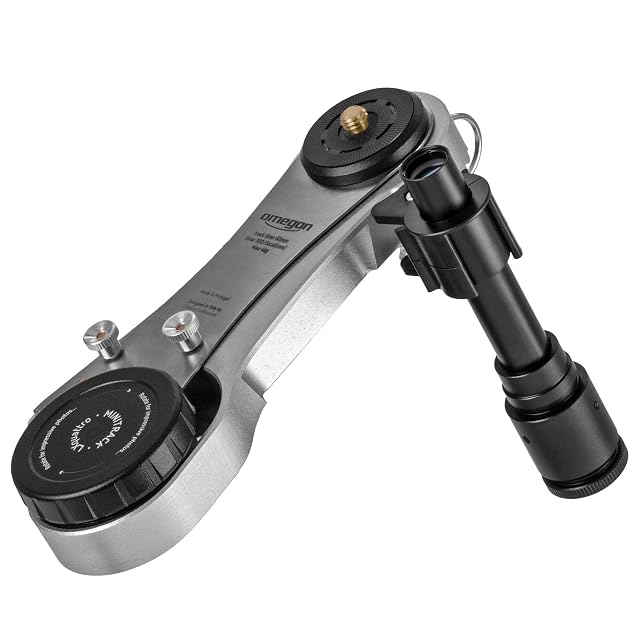
Purely mechanical tracker · 4 kg payload · no batteries
A spring-driven mechanical star tracker for cameras and light telephoto lenses, carrying up to four kilograms and running without any power source at all.
Best for: Wide-field night sky photography on foot, far from any power
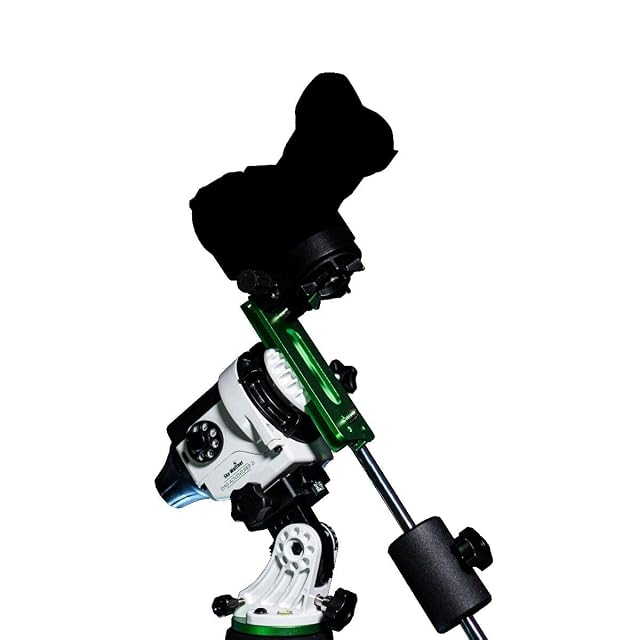
Motorised tracker · Wi-Fi and manual control · illuminated polar scope
A motorised photographic tracking mount with Wi-Fi control from a free app, an illuminated polar finder and a DSLR shutter interface for timed sequences.
Best for: Camera-based night sky photography with an alignment routine that is properly supported