A camera, a lens and one motor against the rotation · review
Omegon MiniTrack LX Quattro NS review
A spring-driven mechanical star tracker for cameras and light telephoto lenses, carrying up to four kilograms and running without any power source at all.
The bottom line The tracker that cannot run out of power, with a published payload and an unpublished running time.
A spring instead of a battery
The whole argument for this design is that it has no electrical parts. It is wound by hand, it turns at sidereal rate, and it works at minus ten degrees exactly as it works at twenty. For anyone who has watched a power bank die halfway through a sequence, that is not a small thing.
Four kilograms, published
Payload is the number that sizes a tracker, and Omegon prints it: up to four kilograms, with wide-angle and light telephoto lenses named as the intended optics. As always, a published capacity describes smooth tracking rather than the point at which something breaks.
What has to be bought separately
A tripod, a ball head and a means of polar alignment. The tracker is the middle of a chain, and the listing does not pretend otherwise.
The number that never appears
Running time per winding. Everything else about how this device is used follows from it, and it is not in the advertisement.
Availability
German, French, Italian and Spanish Amazon stores ran from 256 € to 262 € on the day of the survey.
American and British Amazon catalogues hold a record for it that nobody is selling.
Figures as Keepa reported them on the day this page was last updated. Stock and pricing shift without warning.
Prices quoted in this text were read on 17 September 2026. The live price is at the top of the page.
What it publishes, and what it withholds
Strengths
No batteries at all — nothing to flatten in the cold, ever
A published payload figure of 4 kg, which is the number that sizes a tracker
Wind and go: the setup is polar alignment and nothing else
Compromises
A wound mechanism runs for a limited period and then has to be rewound
No tripod, ball head or polar finder is included in this listing
Mechanical drives cannot be guided or rate-corrected electronically
Specifications
Payload
Up to 4 kg, as the maker publishes it
Counterweight
Not published by the maker.
Tracking rates
Not published by the maker.
Polar alignment method
Not published by the maker.
Power source
Purely mechanical, wound by hand; no batteries and no mains supply
Weight
Not published by the maker.
Head fitting
Not published by the maker.
Amazon reference
B09GXR488N (same reference on 6 Amazon marketplaces)
EAN
4049467693079
What observers ask about this one
How long does one winding last?
The listing does not say. It is the figure that decides how long a single exposure sequence can run before the mechanism has to be reset, and it is the one number this otherwise well-specified product does not publish.
Why choose mechanical over motorised?
Cold. A battery loses capacity as the temperature drops, and winter is when the sky is best. A spring does not care, and it weighs less than the cells it replaces.
13 kg stated capacity · GP-level dovetail · 4.9 kg head
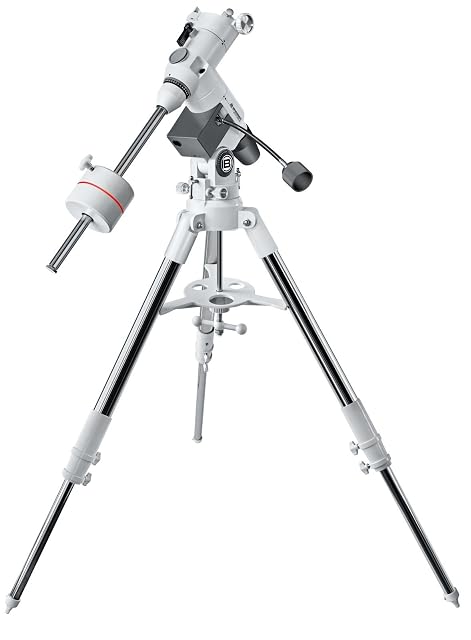
An equatorial mount head with radial ball bearings on both axes, a stated capacity of 13 kg, a polar finder and a 4.5 kg counterweight, on a height-adjustable aluminium tripod.
Best for: Carrying a serious tube steadily, with room to motorise later
Motorised tracker · Wi-Fi and manual control · illuminated polar scope
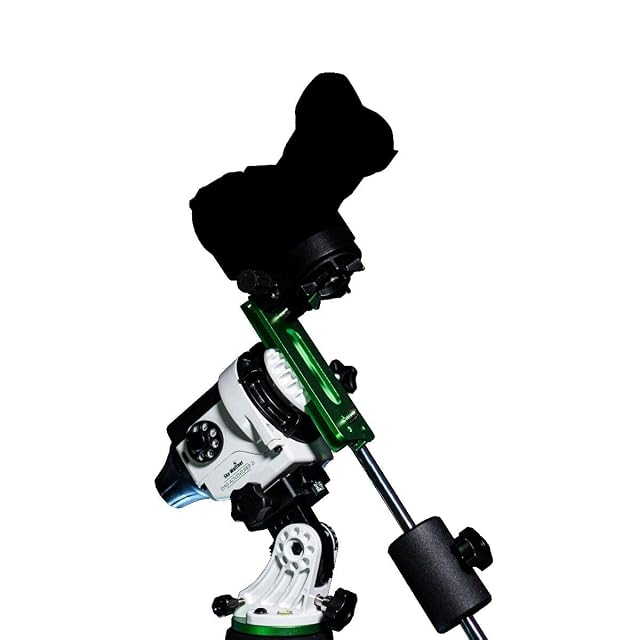
A motorised photographic tracking mount with Wi-Fi control from a free app, an illuminated polar finder and a DSLR shutter interface for timed sequences.
Best for: Camera-based night sky photography with an alignment routine that is properly supported