Skip to content

Bresser Polaris 102/460 EQ3 vs Omegon N 114/900 EQ-1

EQ-3 or EQ-1, and does the number mean anything?

Both are sold as complete instruments and catalogued by their mount. The mount numbers suggest a hierarchy, and neither listing publishes the figure that would confirm it: what each will actually carry. One does publish a packed weight, which at least says something about what has to be carried outside.

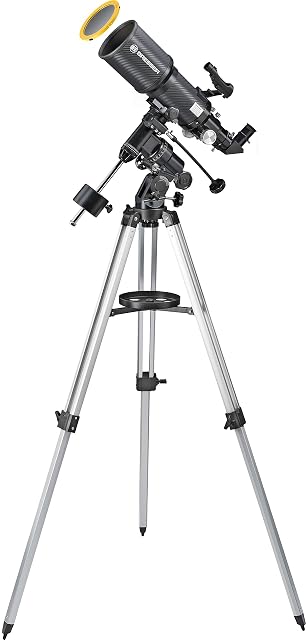
Bresser Polaris 102/460 on its EQ-3 mount with the objective solar filter fitted

Bresser Polaris 102/460 EQ3

Wins 1 of 8

Check price

≈ £255 / €249

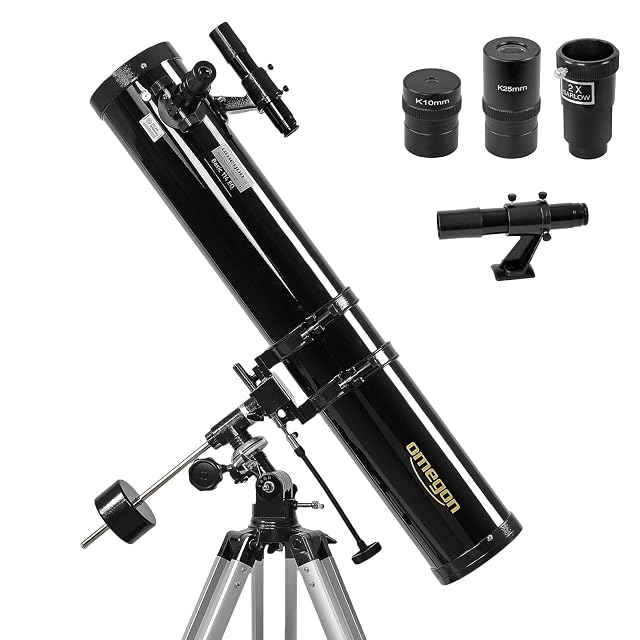
Omegon N 114/900 Newtonian on its EQ-1 equatorial mount

Omegon N 114/900 EQ-1

Wins 2 of 8

Check price

≈ $399 / €239

Line by line

Compared on Polaris 102/460 EQ3 N 114/900 EQ-1
Payload rating Not published by the maker. Absent from this listing
Periodic error Not published by the maker. Not published by the maker.
Drive Not published by the maker. Not published by the maker.
Polar alignment provision Not published by the maker. Not published by the maker.
Counterweight supply Not published by the maker. Not published by the maker.
Tripod EQ-3 equatorial EQ-1 equatorial with two-axis slow motion, on a height-adjustable aluminium tripod
Heaviest single piece 90 × 90 × 140 cm, 8.1 kg, as the maker publishes them Not published by the maker.
Supplied optics 102 mm at 460 mm, f/4.5, with a 2 in focuser and a 1.25 in reducing sleeve 114 mm at 900 mm, f/7.9, Newtonian with a metal tube per the maker

A tick means one listing published something the other did not, or published a better figure. It does not mean the product is better, and the column is not a score out of anything: a maker who says less loses lines here without losing a comparison. The two verdicts below are where the page is settled.

Which one, for whom

Buy the Bresser Polaris 102/460 EQ3

The one that gives a weight. Eight point one kilograms packed, with its outside dimensions, is the figure that decides whether this goes in a car boot or stays in a spare room. Its optical side is fast — f/4.5 on 102 mm — and it is supplied with an objective solar filter whose use is governed by the instructions that come with it.

Buy the Omegon N 114/900 EQ-1

The one with slow motion on both axes. On an equatorial mount without a drive, slow-motion controls are how an object is kept in view, and naming them is worth more than the mount number. At f/7.9 the Newtonian is the more forgiving of the two optically.

What observers ask about these two

What does EQ-1 or EQ-3 actually mean?

They are size classes used across several makers, roughly in ascending order of capacity. Neither is a standard with a published payload, which is why this site treats the absence of a payload figure as the finding.

Why does payload matter more than the class number?

Because the mount, not the tube, decides whether the image holds still. A tube within the mount’s capacity is steady; the same tube slightly over it shakes for seconds after every touch.

Is the supplied solar filter safe to use?

This site reports what the maker publishes and refers to the instructions supplied with the product. Those instructions govern inspection before use, fitting and storage, and they are the authority here — not this page.

The full reviews

  • Bresser Polaris 102/460 EQ3

    102 mm · 460 mm focal length · EQ-3 mount · objective solar filter supplied

    A 102/460 telescope on an EQ-3 equatorial mount, supplied with an objective solar filter for white-light observation, a 2 in focuser with a 1.25 in reducer and a smartphone adapter.

    Best for: Wide-field night use with a daytime solar option, on a mount that can carry both

    ≈ £255 / €249

Any figure written into the body of this page was true on the day it was written. The amount shown next to each instrument is requested from the retailer as the page loads, and it is that amount, not the text, that stands.