Skip to content

Celestron Advanced VX (91519) vs Bresser Messier EXOS-2 EQ

Fourteen kilograms with GoTo, or thirteen with bearings?

Two equatorial mounts of similar stated capacity, published on opposite terms. One gives its capacity and an alignment routine that works without sight of Polaris; the other gives its bearings, its dovetail standard and what the head alone weighs.

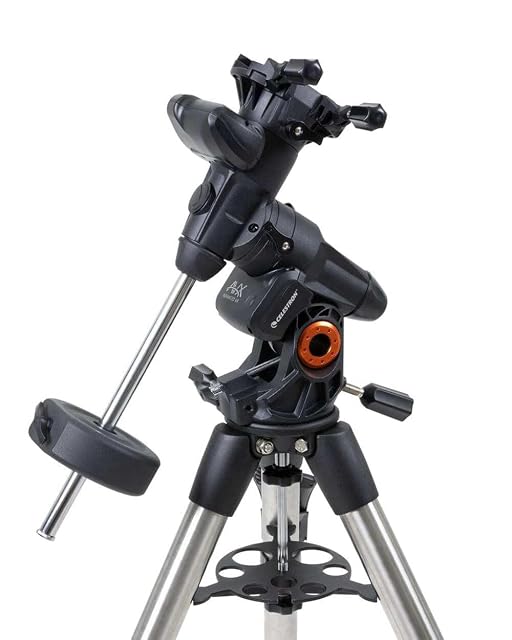
Celestron Advanced VX computerised equatorial mount

Celestron Advanced VX (91519)

Wins 2 of 7

Check price

≈ $1099 / €1199

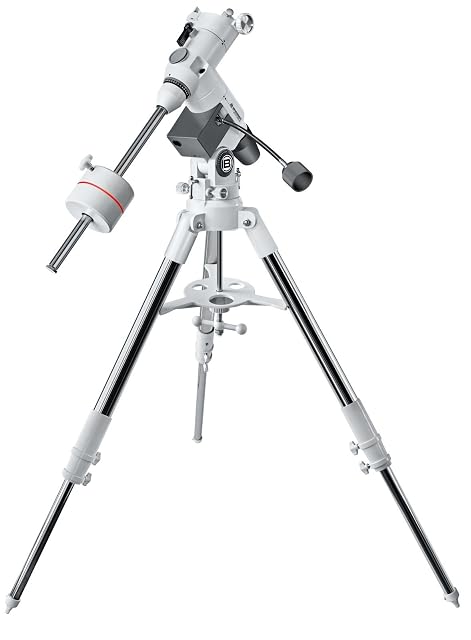
Bresser Messier EXOS-2 equatorial mount on its aluminium tripod

Bresser Messier EXOS-2 EQ

Wins 3 of 7

Check price

≈ £539 / €568

Line by line

Compared on Advanced VX (91519) Messier EXOS-2 EQ
Payload 14 kg, as the maker publishes it Up to 13 kg, as the maker publishes it for the tripod
Counterweight Not published by the maker. Not published by the maker.
Tracking rates Not published by the maker. Radial deep-groove ball bearings on both axes, per the maker
Polar alignment method No polar finder and no clear view of Polaris required, as the maker states it Not published by the maker.
Power source Not published by the maker. Not published by the maker.
Weight Absent from this listing 4.9 kg, as the maker publishes it
Head fitting Not published by the maker. GP-level prism seat

A tick means one listing published something the other did not, or published a better figure. It does not mean the product is better, and the column is not a score out of anything: a maker who says less loses lines here without losing a comparison. The two verdicts below are where the page is settled.

Which one, for whom

Buy the Celestron Advanced VX (91519)

The one that aligns without Polaris. For an observer whose sky is blocked to the north — a wall, a building, a hedge — that single stated capability decides whether the mount can be used at all. Its own weight is not published, which on a mount that has to be carried out is an omission.

Buy the Bresser Messier EXOS-2 EQ

The one that publishes its mechanics. Radial deep-groove bearings on both axes and a GP-level prism seat say how the mount is built and what will bolt to it; 4.9 kg for the head says what has to be lifted. Polar alignment is not described anywhere in the listing.

What observers ask about these two

Why does a dovetail standard matter on a mount?

Because it decides which telescopes can be attached without an adapter. A GP-level seat accepts the narrow bars that most small and medium tubes carry.

Is 13 or 14 kg a meaningful difference?

Barely. What matters far more is how much of that capacity is used: both mounts behave better at half their rating than near it, particularly for imaging.

Can a mount be polar-aligned without seeing Polaris?

Yes — by measuring the drift of stars over time, or by a routine that models the sky from several pointings. One of these mounts states that its routine does not need Polaris in view.

The full reviews

  • Bresser Messier EXOS-2 EQ

    13 kg stated capacity · GP-level dovetail · 4.9 kg head

    An equatorial mount head with radial ball bearings on both axes, a stated capacity of 13 kg, a polar finder and a 4.5 kg counterweight, on a height-adjustable aluminium tripod.

    Best for: Carrying a serious tube steadily, with room to motorise later

    ≈ £539 / €568

Any figure written into the body of this page was true on the day it was written. The amount shown next to each instrument is requested from the retailer as the page loads, and it is that amount, not the text, that stands.