Skip to content

Celestron Regal M2 20-60x80 (52305) vs Omegon Zoom 20-60x80 (73996)

Same 20–60x80 on paper — what separates them?

Same aperture, same zoom range, same exit pupil at both ends, because all three follow from the numbers in the name. Everything that actually differs is in the glass, the body and whether the eyepiece can be changed — and one of the two takes astronomical eyepieces.

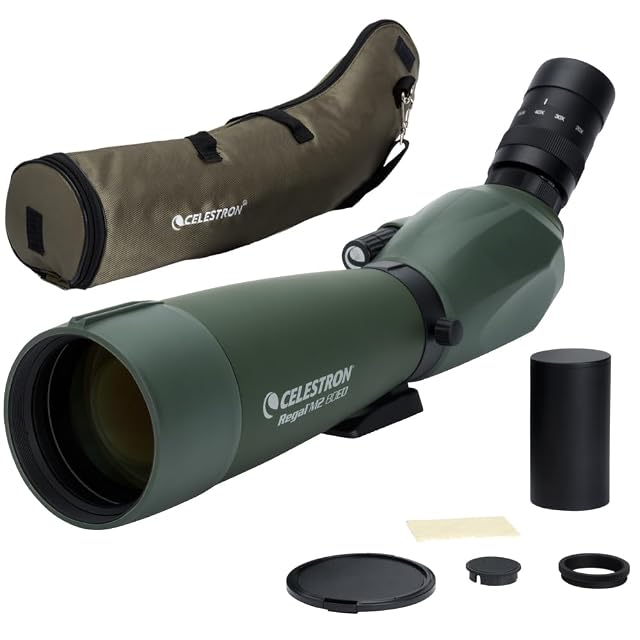
Celestron Regal M2 20-60x80 ED spotting scope in green

Celestron Regal M2 20-60x80 (52305)

Wins 5 of 8

Check price

≈ $799 / £786 / €718

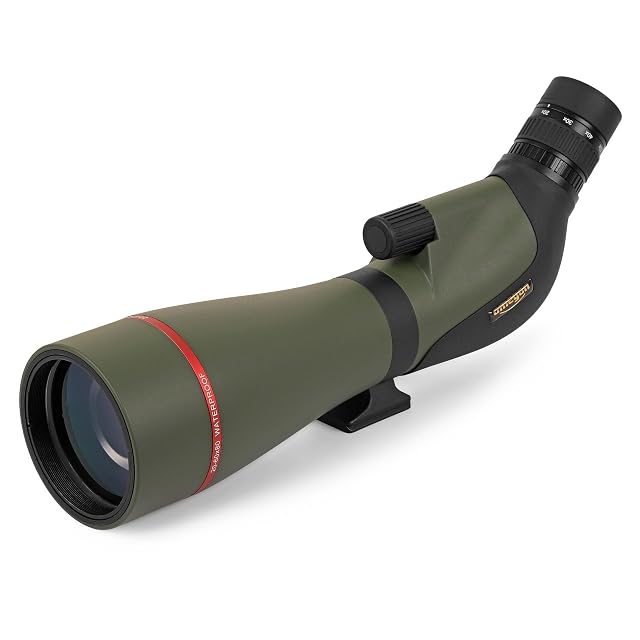
Omegon 20-60x80 zoom spotting scope with dew shield extended

Omegon Zoom 20-60x80 (73996)

Wins 0 of 8

Check price

≈ €159

Line by line

Compared on Regal M2 20-60x80 (52305) Zoom 20-60x80 (73996)
Aperture 80 mm 80 mm
Zoom range 20x to 60x with the supplied zoom eyepiece 20x to 60x with the zoom eyepiece
Exit pupil 4 mm at 20x falling to 1.3 mm at 60x 4 mm at 20x falling to 1.3 mm at 60x
Body shape Magnesium alloy, described by the maker as lighter than aluminium Not published by the maker.
Glass type ED — extra-low dispersion, per the maker Not published by the maker.
Coatings XLT fully multi-coated, the maker’s own name Anti-reflection coating, per the maker; no label or figure is given
Focusing Dual, coarse and fine Not published by the maker.
Eyepiece fitting Standard 1.25 in — astronomical eyepieces can be fitted, stated by the maker Built-in zoom; no eyepiece change is possible

A tick means one listing published something the other did not, or published a better figure. It does not mean the product is better, and the column is not a score out of anything: a maker who says less loses lines here without losing a comparison. The two verdicts below are where the page is settled.

Which one, for whom

Buy the Celestron Regal M2 20-60x80 (52305)

The one that becomes a telescope. A standard 1.25 in eyepiece mount means any eyepiece on this site can be used in it, which is rare on a spotting scope and changes what the instrument is for. ED glass, a named coating and dual focus are all published, and the body is magnesium rather than unstated.

Buy the Omegon Zoom 20-60x80 (73996)

The one sold on the headline figures. Twenty to sixty times on eighty millimetres, a retractable dew shield and a tripod thread, with the glass, the body and the focusing left unstated. Its zoom is built in, so the instrument is what it is on the day it arrives.

What observers ask about these two

Why is the exit pupil identical?

It is aperture divided by magnification: 80 over 20 at the low end, 80 over 60 at the high end. Both scopes carry the same two numbers, so both give 4 mm and 1.3 mm.

What does 1.3 mm of exit pupil mean at night?

It is a small beam entering the eye, so the image is dim and any floaters in the observer’s own eye become visible. It works in daylight and is hard work after dark.

Is ED glass worth it on a spotting scope?

It reduces the colour fringing that shows on high-contrast edges at high zoom — a dark branch against a bright sky, or a lunar limb. Whether it is worth the difference depends on how much time is spent at 60x.

The full reviews

  • Celestron Regal M2 20-60x80 (52305)

    20–60x · 80 mm ED · 1.25 in eyepiece mount · magnesium body

    An ED-glass 20–60x80 angled spotting scope in a magnesium alloy body, with XLT coatings, dual focus, a rotating tripod collar, a 1.25 in astronomical eyepiece mount and a T-adapter ring.

    Best for: The observer who wants one instrument for birds by day and the Moon and planets by night

    ≈ $799 / £786 / €718

  • Omegon Zoom 20-60x80 (73996)

    20–60x · 80 mm · photo thread · retractable dew shield

    A 20–60x80 zoom spotting scope with anti-reflection coating, a retractable dew shield and a photographic tripod thread, sold as an entry-level nature observation instrument.

    Best for: A first spotting scope where the dew shield and the tripod thread do the work

    ≈ €159

Any figure written into the body of this page was true on the day it was written. The amount shown next to each instrument is requested from the retailer as the page loads, and it is that amount, not the text, that stands.