Skip to content

Sky-Watcher Mercury-707 vs SOLOMARK 80900

Which 70–80 mm refractor, and can the listing be trusted?

One of these publishes a focal length twice, differently, in the same listing. That is the first thing a buyer needs to know, because focal length is what turns an eyepiece into a magnification. The other publishes a single figure and ten more millimetres of aperture.

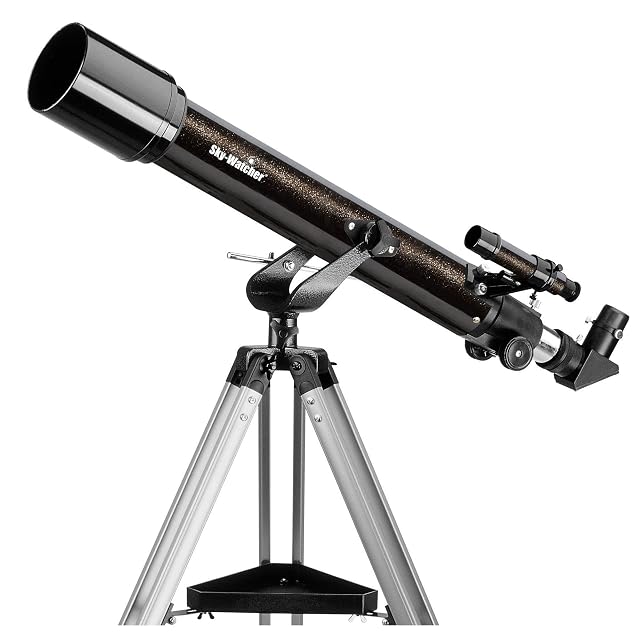
Sky-Watcher Mercury-707 refractor in silver on its aluminium tripod

Sky-Watcher Mercury-707

Wins 3 of 8

Check price

≈ €171

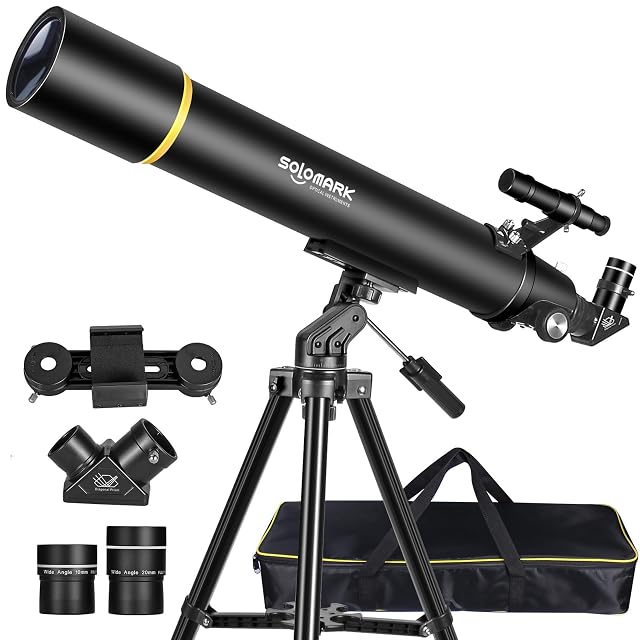
SOLOMARK 80900 refractor on its full-height aluminium tripod

SOLOMARK 80900

Wins 3 of 8

Check price

≈ $70

Line by line

Compared on Mercury-707 80900
Aperture 70 mm (title and bullet agree) 80 mm (title and bullet agree)
Focal length The title says f/700; a supplied-items bullet says 70 mm f/900 — both are reproduced here, neither is chosen 900 mm (from the title)
Focal ratio Not derivable while two focal lengths stand f/11.3, the quotient of the two figures above
Lens design Refractor, multi-coated objective per the maker’s bullet Refractor, coated objective per the maker’s bullet
Glass type Not published by the maker. Not published by the maker.
Focuser Not published by the maker. Not published by the maker.
Tube weight Aluminium Not published by the maker.
Supplied accessories 10 mm and 25 mm eyepieces in 1.25 in, 6x24 finder, 2x Barlow, star diagonal, alt-azimuth mount, aluminium tripod with tray 20 mm and 10 mm wide-angle eyepieces, erecting diagonal, phone adapter, carry bag

A tick means one listing published something the other did not, or published a better figure. It does not mean the product is better, and the column is not a score out of anything: a maker who says less loses lines here without losing a comparison. The two verdicts below are where the page is settled.

Which one, for whom

Buy the Sky-Watcher Mercury-707

The better-equipped box, with a contradiction in it. Two eyepieces in the 1.25 in standard, a Barlow, a finder, a diagonal, a mount and a tripod — and a listing that gives 700 mm in the title and 900 mm in a supplied-items line. Until that is resolved, no magnification quoted for it can be relied on.

Buy the SOLOMARK 80900

The one whose arithmetic works. Eighty millimetres at 900 mm is f/11.3, and a long achromat is where a two-glass objective shows least colour. What arrives with it is a shorter list, and an erecting diagonal is a daytime accessory rather than an astronomical one.

What observers ask about these two

Why does a contradictory focal length matter so much?

Because every magnification follows from it. A 10 mm eyepiece gives 70x on a 700 mm telescope and 90x on a 900 mm one, and the focal ratio — which governs how much false colour an achromat shows — changes with it too.

Is an erecting diagonal useful for astronomy?

Rarely. It adds glass to correct an image orientation that does not matter on the sky, and each extra surface costs a little light. It is there for daytime use.

Does 10 mm more aperture matter at this size?

Eighty against seventy is about thirty per cent more light. It is a real gain, and smaller than the difference a steady mount makes at the same magnification.

The full reviews

Any figure written into the body of this page was true on the day it was written. The amount shown next to each instrument is requested from the retailer as the page loads, and it is that amount, not the text, that stands.