Skip to content

Bresser Pluto EQ 114/500 vs Omegon Advanced 130/650 EQ-320

A fast 114 mm or a parabolic 130 mm?

Sixteen millimetres of aperture separate these two, and rather more than that separates what their listings say. One publishes a mirror figure and a focuser size; the other publishes a box of accessories. On a Newtonian, the first pair of facts outlasts the second.

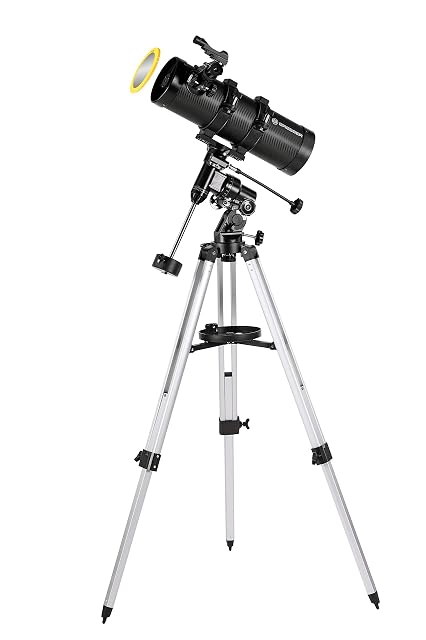
Bresser Pluto 114/500 Newtonian reflector on its equatorial mount

Bresser Pluto EQ 114/500

Wins 1 of 9

Check price

≈ €199

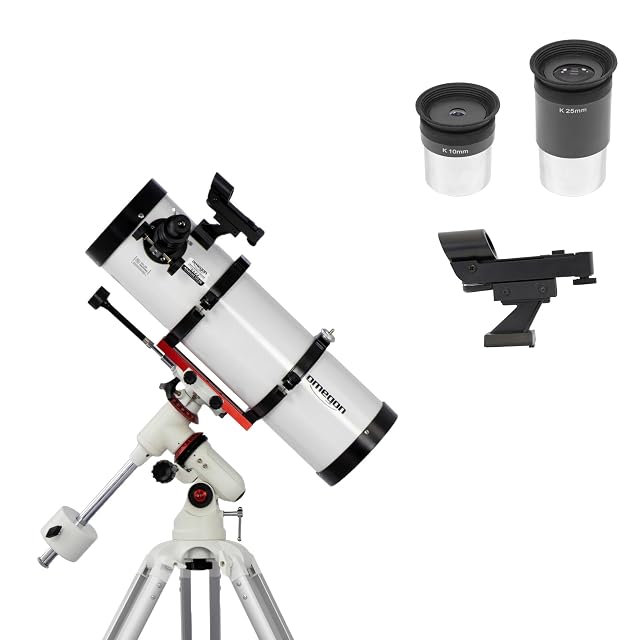
Omegon Advanced 130/650 reflector on its EQ-320 equatorial mount

Omegon Advanced 130/650 EQ-320

Wins 6 of 9

Check price

≈ €409

Line by line

Compared on Pluto EQ 114/500 Advanced 130/650 EQ-320
Aperture 114 mm (from the title) 130 mm (from the title)
Focal length 500 mm (from the title) 650 mm (from the title)
Focal ratio f/4.4, the quotient of the two figures above f/5, the quotient of the two figures above
Optical design Newtonian reflector Newtonian reflector with parabolic primary, stated by the maker
Mirror coating Not published by the maker. Not published by the maker.
Focuser type Not published by the maker. 1.25 in, described as compatible with other makers’ accessories
Collimation access Primary and secondary both adjustable, stated by the maker Fully adjustable, stated by the maker
Mount supplied Equatorial, with aluminium tripod EQ-320 equatorial with tracking gear
Supplied accessories 20 mm and 4 mm eyepieces, 3x Barlow, LED finder, smartphone camera adapter, accessory tray Illuminated LED finder

A tick means one listing published something the other did not, or published a better figure. It does not mean the product is better, and the column is not a score out of anything: a maker who says less loses lines here without losing a comparison. The two verdicts below are where the page is settled.

Which one, for whom

Buy the Bresser Pluto EQ 114/500

The fuller box. Two eyepieces, a Barlow, a finder, a phone adapter and a tray, at the shorter focal length of the two. What the listing never says is what shape the primary mirror is — and at f/4.4, a spherical mirror does not bring a star to a point. The omission is the finding.

Buy the Omegon Advanced 130/650 EQ-320

The one that says what its mirror is. A parabolic primary at f/5, a named focuser size, and a mount with a tracking drive. Almost nothing is listed as supplied beyond a finder, so eyepieces are a separate purchase — but they are the part that can be bought later, and the mirror is not.

What observers ask about these two

Why does the mirror shape matter at f/4.4?

A spherical mirror focuses light from its centre and its edge at slightly different points, and the faster the mirror, the wider that gap. At f/4.4 it is visible; at f/8 it is not. A parabolic mirror does not have the problem at all.

Is 130 mm much more than 114 mm?

The light collected goes with the square of the aperture, so about thirty per cent more. That is a real difference on faint objects, though not a transformation.

Does a tracking drive replace a GoTo?

No. A tracking drive keeps an object in the eyepiece once found; a GoTo mount finds it. They solve different halves of the problem.

The full reviews

Any figure written into the body of this page was true on the day it was written. The amount shown next to each instrument is requested from the retailer as the page loads, and it is that amount, not the text, that stands.