Skip to content

Sky-Watcher Heritage 130P FlexTube vs Omegon Advanced X N 203/1200

Tabletop or full-size Dobsonian?

A Dobsonian is an aperture on a box that needs no alignment. These two apply that idea at opposite ends: one collapses onto a table, the other is the largest aperture in this group. The choice is less about optics than about where the telescope will be put down.

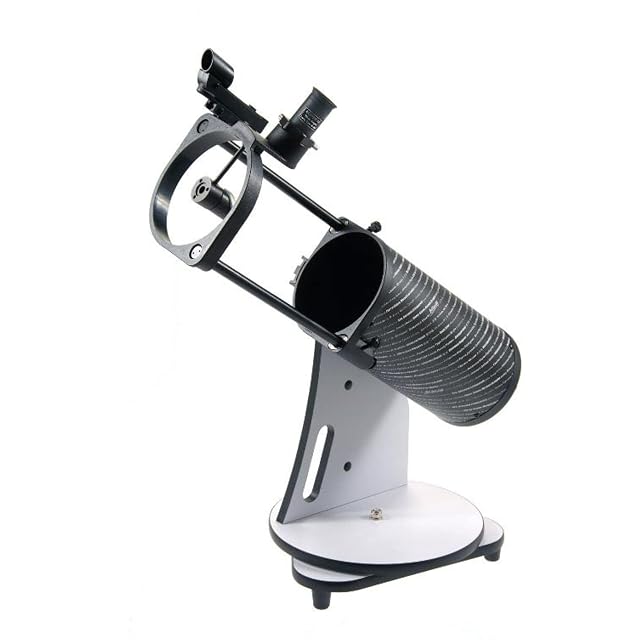
Sky-Watcher Heritage 130P FlexTube collapsed on its wooden base

Sky-Watcher Heritage 130P FlexTube

Wins 2 of 8

Check price

≈ £264 / €273

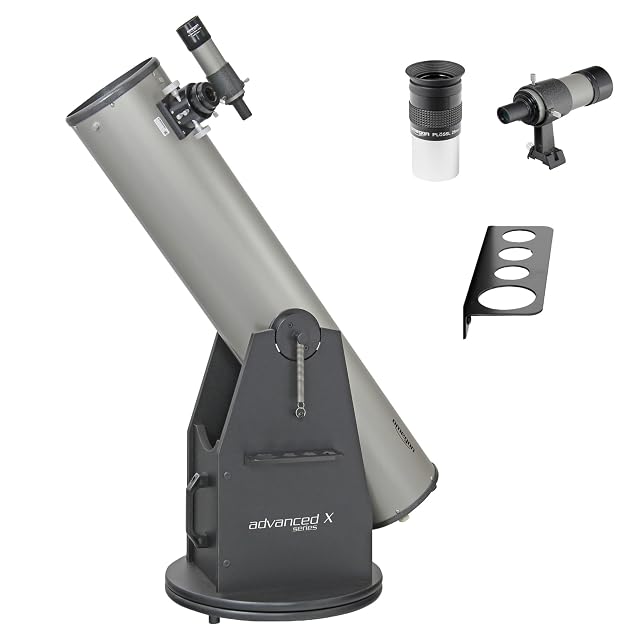
Omegon Advanced X 203/1200 Dobsonian on its rocker box

Omegon Advanced X N 203/1200

Wins 2 of 8

Check price

≈ €529

Line by line

Compared on Heritage 130P FlexTube Advanced X N 203/1200
Aperture 130 mm (maker’s supplied-items line) 203 mm (from the title and bullets)
Focal length 650 mm (maker’s supplied-items line) 1200 mm (maker’s bullet)
Focal ratio f/5, the quotient of the two figures above f/5.9, the quotient of the two figures above
Base Alt-azimuth wooden Dobsonian, tabletop height Not published by the maker.
Bearing design Not published by the maker. Not published by the maker.
Tube construction Parabolic Newtonian, collapsible tube Newtonian reflector on a Dobsonian base
Heaviest single part Not published by the maker. Not published by the maker.
Eyepiece height Not published by the maker. Not published by the maker.

A tick means one listing published something the other did not, or published a better figure. It does not mean the product is better, and the column is not a score out of anything: a maker who says less loses lines here without losing a comparison. The two verdicts below are where the page is settled.

Which one, for whom

Buy the Sky-Watcher Heritage 130P FlexTube

The one that gets used. A collapsible tube on a tabletop base goes out on a weeknight, which a 203 mm Dobsonian frequently does not. Its listing also names the mirror as parabolic — at f/5 that is not a detail — and it is the only one of the two to describe its base at all.

Buy the Omegon Advanced X N 203/1200

The one that shows more. Two hundred and three millimetres against a hundred and thirty is roughly two and a half times the light, and on faint objects there is no substitute for it. Neither the base nor the heaviest single part is published, and on an instrument this size those are precisely the figures that decide whether it leaves the house.

What observers ask about these two

What does a tabletop Dobsonian sit on?

Anything solid at roughly seating height — a garden table, a stool, a crate. The base has no tripod, which is what makes it light, and it needs a steady surface rather than a level one.

Why is eyepiece height worth publishing?

Because it decides whether the observer stands, stoops or sits, and it changes as the telescope swings from the horizon to the zenith. Neither listing here gives it.

Is a Dobsonian harder to set up than an equatorial?

It is easier. There is nothing to align: the base moves left-right and up-down, which is how a person looks around. The trade is that it does not track, so objects drift.

The full reviews

Any figure written into the body of this page was true on the day it was written. The amount shown next to each instrument is requested from the retailer as the page loads, and it is that amount, not the text, that stands.